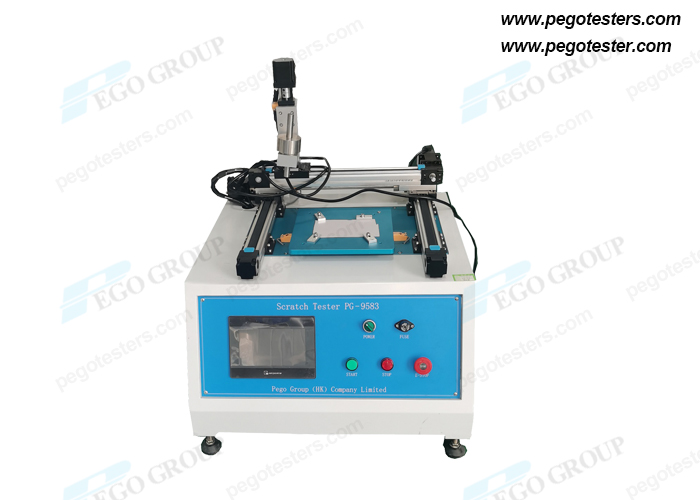
In the global safety standard system for home appliances, IEC60335-1, as a general safety standard for household and similar electrical appliances, acts like an insurmountable red line, building a solid defense for the electrical safety of millions of families. Among the many testing requirements of this standard, the scratch resistance test is undoubtedly a key link in ensuring the safety of electrical appliance casings and easily accessible components. Correspondingly, the IEC60335-1 scratch tester has become the “authoritative judge” to measure whether products meet the standards. Among them, the PEGO scratch tester PG-9583 occupies an important position in this field with its excellent performance.
1. IEC60335-1 Standard
IEC 60335-1 is a key international safety standard, forming the cornerstone for household and similar electrical appliances. Developed by the International Electrotechnical Commission (IEC), it outlines general safety requirements to ensure such appliances are safe for consumer use in domestic and similar settings. Notably, its provisions on scratch resistance testing stem from a deep understanding of home appliance usage scenarios. In fact, during long-term use, transportation, or daily contact, appliance casings’ surfaces inevitably face external forces like friction and scratching. If a material’s scratch resistance is insufficient, its surface coating or substrate is likely to be damaged. This not only harms the product’s appearance but may also expose internal structures. For instance, when an insulating casing is scratched to reveal metal parts, it could pose electric leakage risks. Additionally, for heating appliances, a damaged surface may accelerate material aging and even cause fire hazards.
2. Importance of Scratch Tester
The scratch test simulates daily scratching, assesses material damage resistance under specific conditions, and ensures product safety over its lifecycle. Moreover, it is both a market entry “pass” and a direct reflection of enterprises’ safety commitments to consumers. To facilitate this, the PEGO scratch resistance tester PG-9583 accurately conducts this test, providing reliable basis for product compliance and aiding enterprises in fulfilling safety commitments.
3. Principle of the Scratch Resistance Tester
For the scratch resistance test, we use a hardened steel pin for scratching. Specifically, we taper the end of this steel pin to a 40° apex angle. Furthermore, we round its tip to a radius of 0.25 mm ± 0.02 mm. When performing the scratch test, we carry out the scratching at a speed of 20 mm/s ± 5 mm/s in a plane perpendicular to the edge of the conductor. In addition, we load the steel pin properly so that it applies a force of 10N ± 0.5N along its axial direction. Moreover, we ensure the scratch interval is at least 5mm, and each scratch is at least 5mm away from the edge of the sample. What’s more, the scratch tester features a PLC and touch screen control system, which delivers good performance. Besides, rotating the work surface allows us to easily conduct scratch tests in both directions.
4. Application of Scratch Resistance Tester
The application of the IEC60335-1 scratch resistance tester runs through the entire life cycle of home appliance products, playing a key role in material selection during the R&D stage, quality control during production, and compliance testing before market access.
- Electronics and communications industry: It is used to test components such as the shells and screens of electronic devices. For example, mobile phone shells, tablet computer shells, and smart watch cases, which are mostly made of metal, plastic, or composite materials. The test can verify the ability of products to resist scratches from hard objects such as keys and desktops during daily carrying and use. In addition, the scratch resistance test of screen protectors also relies on this device.
Metal and metal surface treatment industry: It conducts scratch resistance tests on metal surface coatings (such as chromium plating, zinc plating) and oxide layers. For example, the surface treatment layers of hardware (faucets, door locks) need to pass the test to ensure that they are not easily scratched during use, maintaining their aesthetics and rust resistance.
Material research and development and quality control: In the stage of material research and development, the scratch resistance tester can compare the performance of materials made with different formulas and processes, providing data support for optimizing material components (such as adding wear-resistant agents). In production quality control, regular sampling inspections can be conducted to ensure that the scratch resistance of mass-produced materials or products meets the standards, preventing unqualified products from entering the market.
5. Conclusion
Although the IEC60335-1 scratch tester does not directly meet consumers, it has become an indispensable link in the home appliance safety chain with its accurate testing capabilities. Among them, the PEGO scratch tester PG-9583 plays an important role in ensuring the quality of home appliance products and promoting industry development with its excellent performance. It defines the damage resistance limit of materials with scientific data, ensures the consistency of product quality through standardized processes, and ultimately integrates safety and reliability into every home appliance product. In the future, as the home appliance industry continues to upgrade safety standards, the PEGO scratch resistance tester PG-9583 will also continue to iterate, contributing more to building a safer home environment.