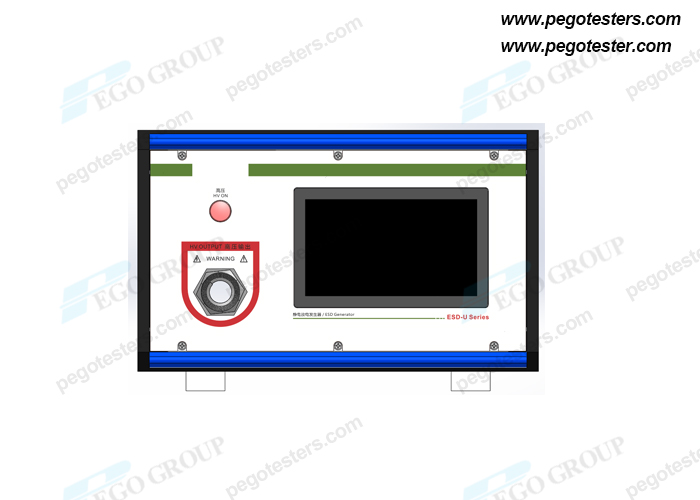
An electrostatic discharge (ESD) generator is a testing device that simulates electrostatic discharge phenomena. Primarily, it is designed to evaluate the electrostatic interference resistance of electronic and electrical products as well as components. Essentially, its core working principle lies in mimicking the process where a human body or an object releases accumulated static electricity instantaneously. The detailed working process is as follows:
1. Core Structural Components
The key components of an ESD generator determine its discharge function. First and foremost, these components include the following parts:
- High-voltage power supply module: It is responsible for generating high-voltage direct current (DC) to charge the energy storage capacitor, thus simulating the process of static electricity accumulation.
- Energy storage capacitor (C): It stores high-voltage electrical energy. Specifically, its capacitance determines the discharge charge amount, with common specifications such as 150 pF (for simulating human body discharge) and 330 pF.
- Discharge resistor (R): It controls the rise rate and duration of the discharge current, and at the same time, it simulates the impedance characteristics of different discharge scenarios—for example, a 330 Ω resistor is usually adopted when simulating human body discharge.
- Discharge electrode: It is divided into contact discharge electrodes (with sharp tips) and air discharge electrodes (with round tips). Accordingly, it is used for direct contact discharge with the tested product or non-contact discharge at a distance.
- Control unit: It sets parameters such as discharge voltage, discharge mode (contact/air), and discharge polarity (positive/negative). Furthermore, it controls the triggering timing of the discharge.
2. Specific Working Procedures
- Static electricity accumulation phase: The control unit activates the high-voltage power supply module to charge the energy storage capacitor. In accordance with international testing standards such as IEC 61000-4-2, the charging voltage can be adjusted to several thousand or even tens of thousands of volts, thereby simulating electrostatic accumulation of varying intensities.
- Discharge triggering phase: When the energy storage capacitor reaches the preset voltage, the control unit triggers the discharge switch. Subsequently, the energy storage capacitor releases the stored charge instantaneously to the tested product through the discharge resistor and discharge electrode.
- Contact discharge: The discharge electrode makes direct contact with the surface of the tested product, which allows the charge to conduct rapidly. As a result, the rising edge of the discharge current becomes steeper.
- Air discharge: The discharge electrode maintains a certain gap from the tested product. The high voltage then breaks down the air to form a discharge channel, thus simulating the non-contact electrostatic discharge scenario.
- Discharge cycle and detection phase: The device can repeat the discharge process at a preset frequency. Meanwhile, it cooperates with other testing instruments to monitor the working status of the tested product after electrostatic discharge. Ultimately, it judges whether the product experiences performance degradation or functional failure.
3. Key Technical Features
- Controllable discharge waveform: The output current waveform must comply with international standards—such as the current waveform specified in IEC 61000-4-2 so as to ensure the consistency and comparability of the test results.
- Flexible polarity switching: It can achieve positive and negative polarity electrostatic discharge, therefore covering the actual situations of different electrostatic accumulation types.
- Safety protection design: It is equipped with functions like overvoltage protection and short-circuit protection, in order to avoid equipment damage and electric shock risks for testing personnel.
- The essential working mechanism of an ESD generator is a cycle of “charging-storing-discharging”. By means of standardized discharge processes, it verifies the reliability of products in electrostatic environments. Consequently, it is widely used in electromagnetic compatibility (EMC) testing across fields such as consumer electronics, automotive electronics, and industrial control.
4. The Critical Role of ESD Generators: From Testing to Industry Reliability
In today’s fast-paced electronics industry, electrostatic discharge (ESD) poses a significant threat to the performance and longevity of sensitive components. As a result, electrostatic discharge generators have emerged as indispensable tools for ensuring product reliability. Unlike basic testing equipment, these devices do not merely replicate static events—they actively simulate real-world scenarios to validate how electronic products withstand electrostatic interference. Moreover, their design and functionality have evolved dramatically over the years, adapting to the growing complexity of modern electronics.
5. How ESD Generators Bridge the Gap Between Lab and Reality
First of all, ESD generators operate on a fundamental yet precise principle: they accumulate static charge, store it temporarily, and then release it in a controlled manner. However, what sets them apart from simple static generators is their ability to mimic specific ESD events defined by international standards such as IEC 61000-4-2. For instance, they can simulate human body discharge (HBM) with a 150 pF capacitor and 330 Ω resistor, or machine discharge (MM) with different capacitance and resistance values. By doing so, they provide manufacturers with accurate data on how products will perform in environments where static buildup is common—such as assembly lines, offices, or consumer use.
Furthermore, modern ESD generators integrate advanced control systems that allow operators to adjust key parameters with high precision. They can switch between positive and negative polarities seamlessly, adjust discharge voltage from a few hundred volts to tens of kilovolts, and choose between contact or air discharge modes. In addition, many models feature built-in safety mechanisms, such as overcurrent protection and automatic shutdown, which protect both the operator and the tested product from damage. As a consequence, these devices not only deliver reliable test results but also ensure a safe working environment.
6. The Evolving Landscape of ESD Testing
Over the past decade, the demand for more sophisticated ESD generators has grown exponentially, driven by the miniaturization of electronic components. Today’s microchips and sensors are far more sensitive to static than their predecessors, meaning even small ESD events can cause irreversible damage. To address this challenge, manufacturers have developed ESD generators with faster rise times and more precise waveform control. These advancements enable the simulation of ultra-fast ESD pulses that mimic the rapid discharge of static electricity in real-world situations.
Additionally, ESD generators now play a crucial role in cross-industry applications. Beyond consumer electronics, they are widely used in automotive electronics to test components like ECUs and sensors, in aerospace to validate avionic systems, and in industrial control to ensure the reliability of PLCs and automation equipment. In each of these sectors, the ability to replicate ESD events accurately helps reduce product failures, lower warranty costs, and enhance brand reputation. For example, a car manufacturer might use an ESD generator to test how a vehicle’s infotainment system withstands static discharge from a driver’s clothing, ensuring uninterrupted performance on the road.
7. Why ESD Generators Are Non-Negotiable for Quality Assurance
In summary, electrostatic discharge generators are more than just testing tools—they are guardians of product quality and reliability. By simulating real-world electrostatic events, adjusting to industry standards, and adapting to technological advancements, they enable manufacturers to identify and address potential ESD vulnerabilities before products reach the market. Moreover, their role in ensuring compliance with international regulations cannot be overstated; many industries require products to pass ESD tests before they can be sold globally.
Looking ahead, as electronics continue to become smaller and more powerful, the importance of ESD generators will only increase. Manufacturers will need devices that can simulate even more complex ESD scenarios, integrate with smart testing systems, and provide real-time data analysis. Fortunately, ongoing innovations in power electronics and control systems are making these capabilities a reality. In the end, ESD generators will remain a cornerstone of quality assurance, helping the electronics industry deliver products that are durable, reliable, and resilient to the challenges of static electricity.