1. Normative standard: IEC 60468
Metallic materials are the cornerstone of modern industry, and their electrical properties directly determine the quality and reliability of related products. As a core electrical parameter of metallic materials, resistance not only reflects the material’s ability to impede electric current but also serves as a key basis for material selection, product design optimization, and safety assurance. The IEC 60468:1974 standard (Method of measurement of resistivity of metallic materials), issued by the International Electrotechnical Commission (IEC), establishes a unified and standardized technical guideline for resistance testing of metallic materials, and has become the core compliance for relevant testing work in the global industrial sector.
2. Core Value of Resistance Testing
In industrial production and engineering applications, resistance testing of metallic materials is by no means a simple parameter measurement, but a key link running through the entire process with its core value reflected in multiple dimensions. From the perspective of material selection, there are significant differences in resistivity among different metals and alloys: low-resistivity materials such as copper and aluminum are the first choice for wire manufacturing. While nichrome, due to its high resistivity and high-temperature resistance, is an ideal material for electric heating elements. Resistance testing is the core method for precise material selection. From the perspective of product quality control, during the smelting and processing of similar metallic materials, resistivity anomalies may occur due to composition deviations and process defects, which in turn affect product performance. For example, in the production of wires and cables, excessive conductor resistance will lead to increased energy loss, intensified heating during current transmission, and even fire hazards. Resistance testing can timely eliminate unqualified products and ensure the safety of downstream links in the industrial chain. In addition, in material aging and fault diagnosis, if metallic materials suffer from corrosion, oxidation, fatigue and other issues after long-term use, their resistivity will change significantly. Real-time monitoring of material status through resistance testing provides a scientific basis for equipment maintenance and replacement.
3. Core of IEC 60468:1974 Standard: Standardized Guidance for Resistance Testing of Metallic Materials
As an authoritative international standard for the measurement of metallic material resistivity, IEC 60468:1974 specifies the scope of application, core indicators and operating procedures of the test. Providing a solid support for the standardization of testing work. Its core content can be summarized as follows:
3.1 Defining Applicable Objects and Test Indicators
The standard clearly defines the scope of application—mainly for solid (non-stranded) metallic conductors and resistor materials, excluding special forms of metallic materials such as stranded conductors. In terms of test indicators, the standard identifies three core measurement objects: Volume Resistivity, Mass Resistivity and Resistance per Unit Length:
1) The volume resistivity is defined as the resistance of a conductor of unit length and unit cross-sectional area. It is an inherent parameter reflecting the material’s own electrical characteristics, independent of material size, and is the core indicator for measuring material conductivity.
2) Mass resistivity is defined as the resistance of a conductor of unit length and unit mass. correlates resistivity with material mass, applicable to scenarios where precise control of material dosage is required.
3) Resistance per unit length directly aligns with the practical application needs of conductors, providing an intuitive basis for the design and quality inspection of products such as wires and cables.
3.2 Standardizing Test Methods and Operating Procedures
IEC 60468:1974 formulates reference methods and regular procedures for resistance testing to ensure the accuracy and comparability of test results. The standard recommends four-terminal method (also known as Kelvin Measurement) as the core test method. This method achieves precise resistance measurement through independent current terminals and voltage terminals, effectively eliminating the interference of test lead resistance and contact resistance on the results. And is particularly suitable for testing low-resistance metallic materials. In terms of operating procedures, the standard specifies requirements for the entire process from sample preparation and environmental calibration to data calculation, forming a complete set of test operation specifications.
4. Key Implementation Points and Influencing Factors of Metallic Material Resistance Testing
When conducting tests in accordance with the IEC 60468:1974 standard, attention should be paid to the following key implementation points, while avoiding the interference of various influencing factors on test results.
4.1 Standardization of Sample Preparation
Sample quality directly determines the accuracy of test results. According to the standard requirements, samples should be processed into a flat and uniform solid form with no defects such as oxide layers, oil stains, or scratches on the surface. Meanwhile, precise measurement of sample dimensions such as length and cross-sectional area is required — errors in dimension measurement will be directly transmitted to the resistivity calculation results, and higher precision is required for samples such as fine wires and thin metal sheets.
4.2 Control of Environmental Factors
Temperature is the most important factor affecting the resistivity of metals: the resistivity of most metals increases with temperature rise, typically by 0.3% to 0.6% for every 1℃ increase. Therefore, the test environment temperature must be strictly controlled, preferably carried out at the standard temperature of 20℃. If the standard temperature requirement cannot be met, the test results should be corrected according to the temperature coefficient of the material. In addition, environmental humidity can also interfere with the test: a high-humidity environment is likely to cause sample surface moisture, increasing surface leakage and thus reducing measurement accuracy. Therefore, the relative humidity of the test environment should usually be controlled below 60%.
4.3 Selection and Calibration of Test Instruments
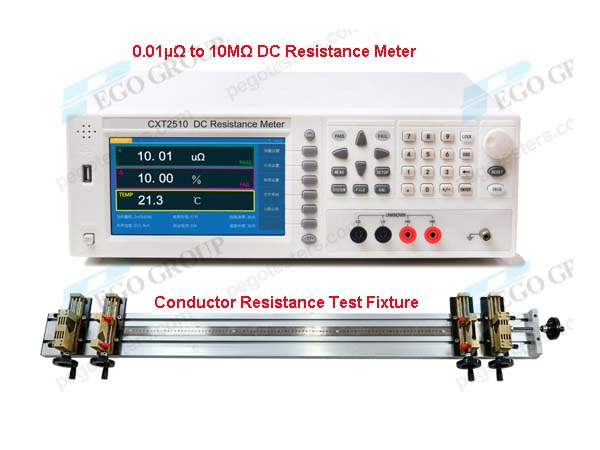
The accuracy and performance of test instruments are the foundation of reliable results, and appropriate instruments should be selected according to the resistance range of the material. For example, when measuring low-resistance metallic materials such as copper and aluminum, a microohmmeter with high precision and strong anti-interference ability should be used. The CXT2510 Ultra-Low DC Resistance Tester launched by PEGO can measure resistance from 0.01µΩ to 10MΩ with a resolution of 0.01µΩ and a test accuracy of 0.02%, which can fully meet the testing needs of low-resistance metallic materials.
4.4 Elimination of Contact Resistance
Contact resistance is one of the most common sources of error in resistance testing. To eliminate its impact, the Four-terminal method recommended by IEC 60468:1974 must be strictly followed, with current terminals and voltage terminals connected separately. Current terminals are responsible for supplying test current to the sample, and voltage terminals are responsible for measuring the voltage drop across the sample. Since the current at the voltage terminals is close to zero, the interference of lead resistance and contact resistance on voltage measurement can be effectively avoided. The conductor resistance fixture developed by PEGO is fully compatible with the Four-terminal method, equipped with four copper terminals (2 voltage terminals and 2 current terminals). When working with the CXT2510 DC Resistance Tester, it can achieve precise testing of resistance of copper and aluminum conductors.

5. Conclusion: Standards Lead Precise Measurement and Empower High-Quality Industrial Development
Resistance testing of metallic materials is a core method for measuring material electrical properties, and its accuracy and standardization are directly related to the quality and safety of industrial products. The IEC 60468:1974 standard provides a unified technical compliance for global metallic material resistance testing by clarifying the test scope, standardizing test methods, and defining precision requirements. Effectively solving the problems of inconsistent test methods and incomparable results in the industry, and promoting the standardization and globalization of metallic material applications.