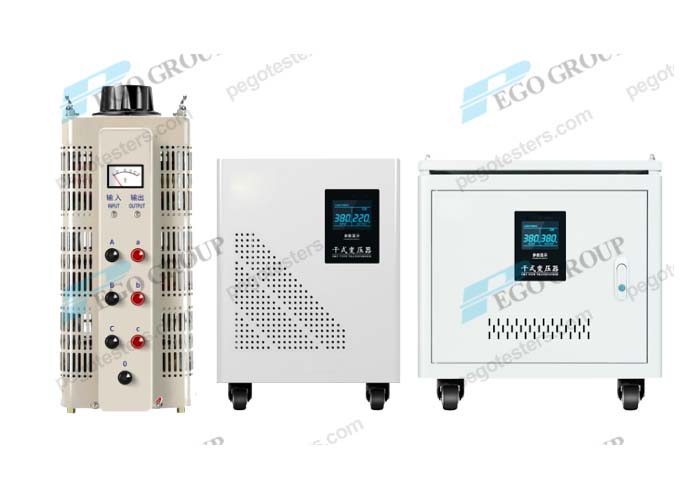
We rely on three essential electrical devices in power systems and industrial production: voltage regulators, transformers and isolation transformers. They seem to share similar functions, but their design objectives and core uses differ greatly. All three work on the principle of electromagnetic induction, yet their core positioning varies significantly. Voltage regulators prioritize adjustable voltage to meet voltage adaptation and stabilization needs. Standard transformers focus on fixed voltage conversion plus efficient power transmission, mainly for voltage level matching. Isolation transformers emphasize electrical isolation and safety protection, prioritizing electrical safety and anti-interference, with voltage conversion only as an additional function.
I. Core Definitions
Voltage Regulator: A voltage adaptation device centered on adjustability. The core feature of a voltage regulator is continuously or stepwise adjustable output voltage. It usually takes a fixed input voltage (e.g., 220V mains supply) and flexibly increases or decreases output voltage on demand. Voltage conversion is not its sole purpose, adjustability is its key attribute. A voltage regulator is essentially a special transformer (mostly auto transformer structure). It designs to achieve precise voltage adjustment, and specifically solves problems like unstable voltage and equipment compatibility with different voltage standards.
Transformer: A basic device focused on fixed voltage conversion and efficient power transmission. Transformers are the most basic voltage conversion components in power systems. Their core functions are fixed-ratio voltage conversion and efficient power transmission. They maintain a fixed input-output voltage ratio (e.g. 220V to 110V, 380V to 220V) and cannot adjust arbitrarily. They design to minimize power loss to the greatest extent and realize efficient power transmission. They mainly apply to long-distance power transmission and voltage level matching between industrial equipment and mains supply, serving as core devices to ensure stable power supply.
Isolation Transformer: A special-function device prioritizing electrical isolation & safety Isolation transformers belong to special-function transformers. Their core goal is to achieve electrical isolation, thus ensuring electrical safety and eliminating interference. In most cases, they feature consistent input and output voltage (e.g., 220V in and 220V out), with voltage conversion only as an additional function.Their core design highlight is independent input and output windings. These windings cut off electrical connection between input and output sides, fundamentally eliminating common-ground interference and risks of electric leakage and electric shock. They design with a focus on safety and anti-interference.
| Type | Voltage Relationship | Core structural features | Losses and Efficiency | Core Function Priority |
| Voltage regulator | The input voltage is fixed, while the output voltage is adjustable to be higher or lower (continuous or stepped regulation) | Most adopt an autotransformer structure, equipped with a voltage regulating mechanism (such as carbon brushes or thyristors), and have no independent isolation winding. | It has slightly higher losses and lower efficiency than standard transformers. | Voltage Regulation > Power Transmission > Safety Protection |
| Transformer | The input and output voltage ratio is fixed and cannot be adjusted arbitrarily. | It consists of an iron core, high-voltage and low-voltage windings, has no voltage-regulating components, and some have a simple shielding structure. | Low losses and high efficiency (efficiency of industrial-grade transformers is over 95%) | Power Transmission > Fixed Voltage Conversion > Voltage Adaptation |
| Isolation transformer | In most cases, the input and output voltages are equal, but the transformer ratio can also be designed as needed. | It features an iron core and independent input/output windings (no common ground connection); some are equipped with shielding layers to enhance anti-interference performance. | Low losses, with efficiency slightly lower than standard transformers but higher than voltage regulators. | Safety Protection > Anti-interference > Power Transmission (Voltage conversion is an additional function) |
II. Typical Practical Scenarios: For Industrial and Foreign Trade Needs
1. Voltage Regulator: A Must for Industrial Commissioning & Voltage Adaptation
The core value of a voltage regulator lies in flexible voltage adjustment, so we widely use it in scenarios requiring precise voltage control:
1). Industrial equipment commissioning and calibration: Before powering on electronic measuring instruments and precision testing equipment, we fine-tune the input voltage with a voltage regulator to ensure the equipment works in a standard voltage environment and guarantee accurate measurement and testing data.
2). Foreign trade equipment compatibility testing: Exported equipment needs to adapt to different national voltage standards (e.g., 110V in the US, 230V in Europe). We can simulate the target market voltage via a voltage regulator to test equipment compatibility.
3). Workshop voltage stabilization: In workshops with large voltage fluctuations (e.g., with large machine tools or electric welders nearby), we equip precision devices (e.g., lab instruments, automatic control systems) with voltage regulators to prevent equipment damage from sudden voltage rises or drops.
2. Transformer: Core Hub for Voltage Level Matching
Transformers form the basis of power transmission and voltage adaptation, focusing on fixed voltage conversion with wide applications:
1). Cross-border equipment power supply adaptation: When exporting 220V domestic industrial equipment to 110V countries (e.g., the US, Japan), we need 220V-to-110V transformers. When a factory’s 380V power supply needs to power 220V devices, we use 380V-to-220V transformers.
2). Industrial power distribution systems: Most factory incoming power is high-voltage (e.g., 10kV). We step it down to 380V (power supply) or 220V (mains supply) via distribution transformers for all types of equipment.
3). Internal equipment power supply: Circuit boards inside electronic instruments and industrial controllers need low-voltage power (e.g., 5V, 12V). Built-in small transformers step down 220V mains supply to protect internal components and ensure safe operation.
3. Isolation Transformer: Shield for Safety & Anti-interference
Isolation transformers mainly serve isolation and safety purposes, so we use them in scenarios with high safety and anti-interference requirements:
1). Precision instrument protection: Electronic measuring instruments and lab testing equipment are sensitive to power grid clutter. Isolation transformers cut off clutter transmission to ensure measurement accuracy and prevent electric shock from equipment leakage, such as in lightning surge testing scenarios.
2). Power supply in high-risk environments: In humid, conductive dust-rich environments (e.g., chemical workshops, electroplating workshops), equipment has high leakage risks. Isolation transformers eliminate ground voltage to reduce electric shock hazards.
3). Safe equipment maintenance: When repairing industrial equipment, we power the to-be-repaired equipment with an isolation transformer. Even if maintenance personnel accidentally touch a wire, no ground loop forms, greatly improving maintenance safety.
III. Conclusion
In short, the three devices differ mainly in design objectives and core functions. Select by needs: voltage regulator for adjustment, transformer for fixed conversion & power transmission, isolation transformer for safety isolation. Clarify needs for accurate selection, avoiding extra costs and safety risks.