
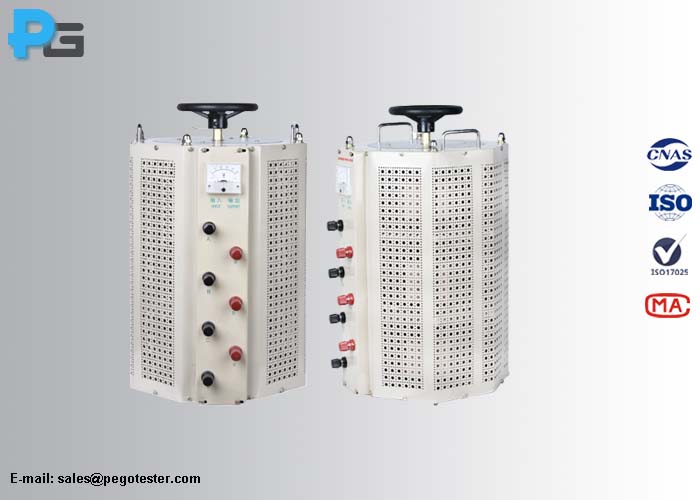
Voltage Regulator
1. Introduction
A voltage regulator is an electrical device that adjusts the rated input voltage to the desired output voltage. It adopts an adjustable autotransformer structure, with its carbon brush assembly driven by the handwheel spindle and brush holder in coordination. The coil is uniformly wound around the toroidal iron core, and the carbon brush is closely attached to the polished surface of the coil under the pressure of the spring. Rotating the handwheel spindle drives the brush holder, making the carbon brush slide along the coil surface. By changing the contact position between the carbon brush and the coil, the turns ratio of the primary and secondary coils is adjusted, ultimately achieving smooth stepless regulation of the output voltage within the adjustment range and fulfilling the purpose of precise voltage regulation.
2. Specification
| Model | TSGC2J |
| Capacity | customization |
| Input voltage | 220V, 380V, 600V (customization) |
| Output voltage | customization |
| Voltage regulation accuracy | ±3% |
| Rated current | Depends |
| Frequency | 50/60Hz |
| Applicable load | Arbitrary load |
| Waveform distortion | No additional waveform distortion |
| Outer dimension/weight | W520mm*D430mm*H1300mm / approximate 115kg |
| Response speed | ≤1.5s (When the external voltage change is ≤10%) |
| Electrical strength | No breakdown or flashover occurred when the power frequency sinusoidal voltage of 1500V was applied for 1 minute. |
| Protection level | IP20 |
| Heat dissipation method | Self-cooling |
| Working condition | 1). Ambient temperature: -15℃~40℃ (temp.) 2). Altitude height :≤ 1500m 3). Installation site: in-door use 4). Average relative humidity: The relative humidity of the air does not exceed 50% when the ambient air temperature is +40℃. Higher relative humidity is possible at lower temperatures. The average maximum relative humidity of the wettest month is 90%, while the average minimum temperature of that month is +25℃. Condensation on the product surface due to temperature changes is also taken into account. 5). The installation site should be free from gases, vapors, chemical deposits, dust, dirt, and other explosive or corrosive media that could seriously affect the insulation of the voltage regulator. 6). The installation site should be free from significant vibration or bumps. |
3. Models
| Model | Rated Capacity (KVA) | Phase | Input (V) | Output (V) | Output current (A) |
| TDGC2-0.2KVA | 0.2 | 1 | 220 | 0-250 | 0.8 |
| TDGC2-0.5KVA | 0.5 | 220 | 0-250 | 2 | |
| TDGC2-1KVA | 1 | 220 | 0-250 | 4 | |
| TDGC2-2KVA | 2 | 220 | 0-250 | 8 | |
| TDGC2-3KVA | 3 | 220 | 0-250 | 12 | |
| TDGC2-5KVA | 5 | 220 | 0-250 | 20 | |
| TDGC2-10KVA | 10 | 220 | 0-250 | 40 | |
| TDGC2-15KVA | 15 | 220 | 0-250 | 60 | |
| TDGC2-20KVA | 20 | 220 | 0-250 | 80 | |
| TDGC2-1.5KVA | 1.5 | 3 | 380 | 0-430 | 2 |
| TDGC2-3KVA | 3 | 380 | 0-430 | 4 | |
| TDGC2-6KVA | 6 | 380 | 0-430 | 8 | |
| TDGC2-9KVA | 9 | 380 | 0-430 | 12 | |
| TDGC2-15KVA | 15 | 380 | 0-430 | 20 | |
| TDGC2-20KVA | 20 | 380 | 0-430 | 26 |


