In the Australian and New Zealand gas appliance market, compliance testing serves as a critical gateway for market entry, quality control, and export certification. As the core general standard for gas appliances in Australia and New Zealand, AS/NZS 5263.0 explicitly outlines the testing specifications for domestic, commercial, and light industrial gas equipment. The standard test vessels support performance verification, emission inspection and compliance for gas cooktops and hotplates. They serve factory quality labs, third-party testing institutions and certification authorities for all standardized testing procedures.
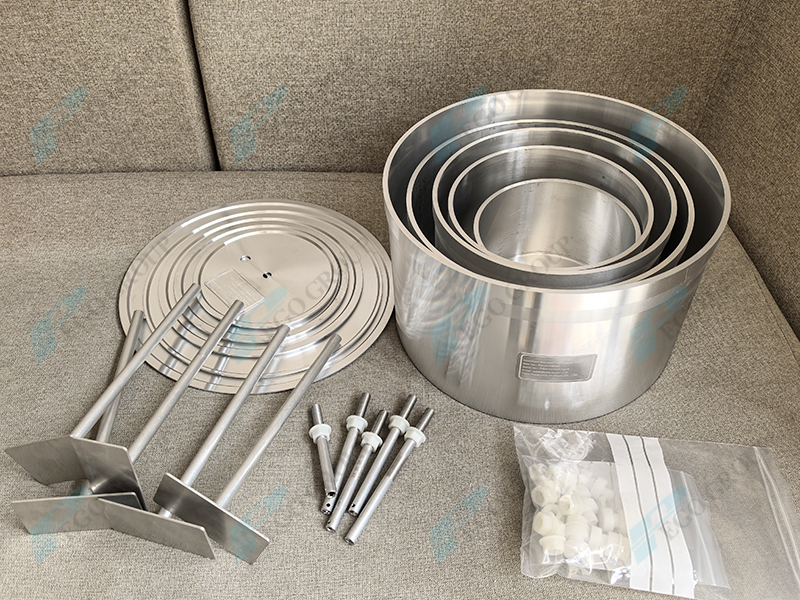
The standard test vessels strictly follow the dimensional and structural requirements of AS/NZS 5263.0:2023 Appendix Figure A.12, and match the full testing specifications of AS/NZS 5263.1.1. Different from IEC and GB standard vessels, they adopt high-purity industrial aluminum and come with complete standard accessories, including aluminum covers, dedicated stirrers, thermocouple wells and sealing connectors. With precise dimensions, uniform thermal conductivity and stable physical properties, they deliver consistent, traceable test data and fully qualify for official AS/NZS compliance tests.
Core Testing Functions for Critical Gas Appliance Performance Verification
AS/NZS 5263.0 test vessels provide standardized high-precision testing carriers for gas appliance evaluation. They effectively avoid test deviations and invalid certification data, and cover new product R&D, mass production sampling, routine quality inspection and official certification testing. Their key application scenarios are as follows:
1. Combustion Completeness Test (CO/CO₂ Ratio Test)
Incomplete combustion causes carbon monoxide hazards and fails safety audits. The standard test vessels simulate real heating conditions, collect combustion flue gas accurately and test CO/CO₂ ratios to evaluate combustion efficiency. They help identify burner defects, improper air intake and incomplete combustion issues, ensuring products meet Australian and New Zealand mandatory safety standards.
2. NOₓ Emission Compliance Test
The Australian and New Zealand markets impose strict regulatory requirements regarding the environmental emissions of gas appliances, specifically, NOₓ emissions constitute a mandatory testing component for product compliance certification. The standardized sealed structure stabilizes test environments and collects accurate flue gas samples. It enables reliable NOₓ emission measurement to help enterprises meet local environmental compliance requirements.
3. Thermal Efficiency Calibration Test
Thermal efficiency determines gas appliance energy efficiency grades and market competitiveness. The five standard vessel sizes cover 0–45 MJ/h gas load ranges, fitting most mainstream Australian and New Zealand gas equipment. Equipped with matched stirrers and precision temperature measurement components, they conduct standardized water heating tests and generate accurate thermal efficiency and energy consumption data for product grading and performance optimization.
4. Low-Fire Stability Safety Test
Flame extinguishing, lift-off and flashback are common safety risks for gas appliances. The standard test vessels simulate minimum-load operating conditions to verify low-flame stability. They detect abnormal combustion problems under low gas pressure and fluctuating airflow, fully validating product safety and operational reliability.
5. Full-Scenario Qualification Testing
The vessels adapt to all qualified household and commercial gas heating equipment within 1000 MJ/h input power. They support prototype testing, batch sampling, official certification and quality rechecks. All test results fully comply with AS/NZS 5263 series audit standards with high credibility and universality.
Standardized Performance and Structural Advantages
Compared to non-standardized test vessels, AS/NZS 5263.0 standard test vessels offer irreplaceable professional advantages: the entire series is constructed from industrially pure aluminum, with wall thicknesses precisely matched to each specific size. This design ensures uniform heat conduction, high-temperature resistance, structural stability (no deformation), and corrosion resistance, resulting in deviation-free data over long-term testing periods. The complete assembly includes a standard aluminum lid, a thermocouple well, a specialized stirrer, and a sealed thermocouple sheath. This full suite of accessories strictly adheres to the official standard specifications, allowing for direct use in compliance testing without the need for any modifications. Furthermore, the range covers five standardized sizes, precisely matching equipment with varying gas loads to eliminate any testing blind spots, thereby ensuring both high detection accuracy and optimal adaptability across diverse application scenarios.
Help Enterprises Accelerate ANZ Market Layout
Reliable standard testing equipment is the foundation of compliant production and successful export. AS/NZS 5263.0 standard test vessels solve common industry problems such as inconsistent test data and low certification pass rates. They provide reliable standardized support for product optimization, quality control and export compliance.
As standard testing equipment widely recognized in the ANZ market, these vessels help enterprises pass official audits efficiently, stabilize product quality and strengthen market competitiveness for long-term local business expansion.