1. Overview of Salt Spray Testing
Corrosion failure acts as a core factor that impairs the service life and operational safety of metal materials, surface-treated components and industrial products. Harsh working conditions such as coastal environments, high humidity and heavy salt fog frequently cause metal rusting, coating peeling and plating failure, which significantly degrade product quality. As a core artificial accelerated corrosion and aging testing method, the salt spray test rapidly simulates natural salt fog corrosion conditions and accurately evaluates the corrosion resistance of metal substrates and various surface protective layers formed by electroplating, spraying and anodizing. It has become an indispensable standardized testing item for industrial production, quality inspection and acceptance, and new product research and development.
China currently adopts GB/T 10125-2021 Artificial Atmosphere Corrosion Tests — Salt Spray Test, which is equivalent to the international standard ISO 9227:2022. Meanwhile, standards including GB/T 2423.17-2024 and ASTM B117 are widely applied in targeted corrosion detection for subdivided industries such as electronics, automobiles and hardware.
2. Core Principles of Salt Spray Test
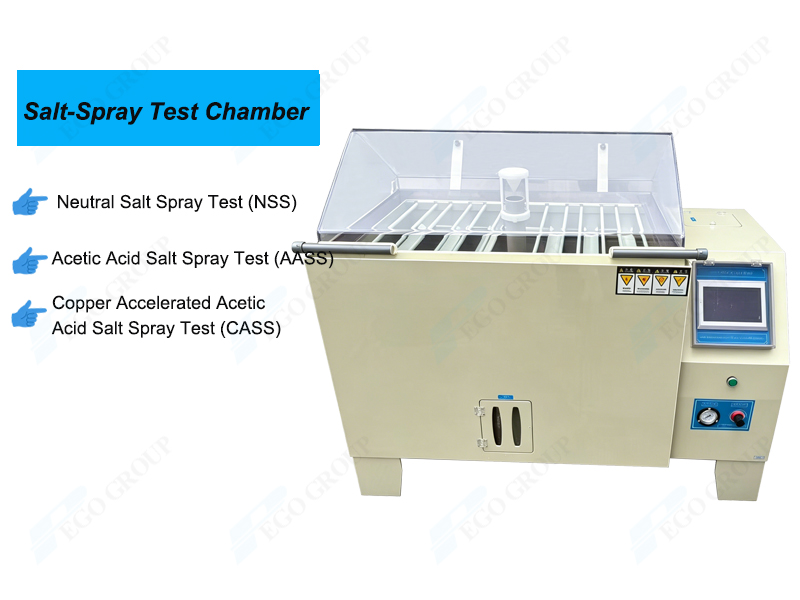
The salt spray test relies on closed professional test equipment and takes electrochemical corrosion as its core mechanism. The equipment atomizes the prepared salt solution to form a uniform and stable salt fog atmosphere inside the sealed chamber. Chloride ions in the salt fog feature strong permeability, which can penetrate the protective coatings and passivation films on product surfaces and trigger electrochemical reactions with metal substrates, thus accelerating the occurrence and development of corrosion defects such as metal oxidation, rusting and peeling.
Unlike the slow corrosion process in natural environments, the salt spray test is an efficient accelerated aging testing technology. It can reproduce the natural corrosion state of products that takes months or even years to form in nature within a short period. It enables testers to effectively evaluate the quality of product surface protection processes, quickly eliminate unqualified products and optimize production processes, thereby greatly improving the overall efficiency of industrial product reliability testing. The conventional constant test temperature is 35℃. Precise control over key parameters including salt solution concentration, pH value and spray sedimentation ensures high accuracy and repeatability of test data.
3. Main Classifications, Test Parameters and Application Scenarios
Based on ISO 9227 standard and differences in salt solution ratio, acidity and alkalinity, and corrosion severity grades, the industry classifies mainstream salt spray tests into three basic types: Neutral Salt Spray test (NSS), Acetic Acid Salt Spray test (AASS), and Copper Accelerated Acetic Acid Salt Spray test (CASS). In addition, the industry has developed the Cyclic Corrosion Test (CCT) for composite corrosion testing. These four types of tests adapt to different materials, surface processes and industrial application scenarios respectively.
3.1 Neutral Salt Spray Test (NSS) — General Basic Test
The NSS test is the most widely used basic corrosion testing method in the industrial field. With mild test conditions, it accurately simulates the corrosion characteristics of conventional atmospheric environments and mild salt fog environments in coastal areas. The test adopts pure sodium chloride aqueous solution with a concentration of 5%±1%. The solution pH value is controlled within 6.5~7.2 at 25℃ room temperature, the test temperature is fixed at 35℃, and the whole test adopts a continuous spraying mode.
It applies to most ordinary metal substrates and conventional surface-protected products, including galvanized hardware, blackened iron parts, aluminum alloy die castings, anodized workpieces, ordinary painted and powder-sprayed products, home appliance metal components, general electronic hardware and lamp housings. It serves as a universal core item for incoming material inspection and conventional finished product quality inspection.
3.2 Acetic Acid Salt Spray Test (AASS) — Special Test for Decorative Coatings
The AASS test prepares weakly acidic test solution by adding glacial acetic acid to sodium chloride salt solution, with the solution pH value stably controlled at 3.1~3.3 and a constant test temperature of 35℃. Compared with the NSS test, the AASS test features a faster corrosion rate and higher test severity, which can accurately detect the protective performance and durability of multi-layer ordinary electroplated coatings.
It is mainly applicable to various decorative electroplated products, including copper-nickel-chromium composite electroplated parts, plumbing pipe fittings, conventional bathroom hardware and furniture decorative chromium-plated parts, and is widely used in the factory quality acceptance of medium and high-end decorative coatings.
3.3 Copper Accelerated Acetic Acid Salt Spray Test (CASS) — Severe Test for High-end Electroplating
The CASS test adds copper chloride as a corrosion catalyst to the acetic acid salt solution to greatly enhance the corrosion activity of the solution. With stronger acidity, the fastest corrosion rate and the highest test severity, it is currently an authoritative testing standard for high-end precision electroplated products. It strictly controls core parameters such as pH value and temperature, and can quickly expose hidden microscopic defects such as tiny cracks and pinholes on high-end precision coatings.
It focuses on the quality detection of high-end precision electroplated products, including automotive exterior decorative electroplated parts, high-end bathroom hardware, precision electronic connectors and jewelry electroplated parts, and acts as a core mandatory test item for product acceptance in the automotive and high-end kitchen and bathroom industries.
3.4 Cyclic Corrosion Test (CCT) — Composite Environment Simulation Test
Breaking through the limitations of traditional single spraying tests, the CCT test adopts a multi-working-condition cyclic testing mechanism, which alternately completes salt fog spraying, damp-heat standing, drying and air-drying, and normal temperature standing processes. It accurately simulates the complex real service environment with alternating fluctuations of outdoor temperature, humidity and salt fog, and effectively solves the problem of large deviation between single salt spray test results and actual product service conditions.
It is mainly applied to high-end industrial products with high reliability requirements and long-term outdoor service, including new energy vehicle structural parts, complete vehicle components, rail transit equipment, outdoor communication base station equipment, photovoltaic brackets and supporting parts for offshore wind power.
4. Industry General Duration Standards for Salt Spray Tests
The industry sets differentiated salt spray test duration according to product materials, surface treatment processes, actual service scenarios and customer acceptance specifications, and has formed a mature and unified graded system for conventional test duration, as detailed below:
Ordinary basic hardware (galvanized and blackened iron parts): conventional test duration: 24h, 48h
Aluminum alloys and anodized parts: conventional test duration: 48h~96h;
Ordinary electroplated and sprayed products: conventional test duration: 48h~96h;
Multi-layer electroplated parts, bathroom hardware and precision connectors (CASS test): conventional test duration: 96h, 120h, 200h;
Automotive and outdoor service products: conventional test duration: 200h~500h;
Military, marine and offshore special equipment: test duration: 500h~1000h and above.
Industry General Reference: A 96-hour neutral salt spray test is roughly equivalent to one year of natural corrosion and aging in ordinary natural environments.
5. Application Value and Industry Significance of Salt Spray Tests
The salt spray test serves as a core technical means for the industrial sector to control product corrosion resistance quality, iterative optimize production processes, and avoid market quality complaints and risks. At present, this testing technology has fully covered mainstream industrial fields including hardware, home appliances, automobiles, bathroom products, electronics, new energy, rail transit and marine engineering, and has become one of the most popular and widely recognized core test items in industrial product reliability testing. It provides solid technical support for the quality stability and long-term safe service of various metal products, and acts as an essential basic testing technology to guarantee the environmental adaptability and service life of industrial products.