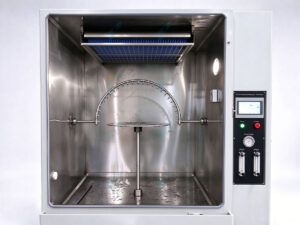
1. What is the draught-proof enclosure?
The draught-proof enclosure is rectangular, with a double skin on top and on at least three sides and with a solid base, the double skins are of perforated metal, space approximately 150mm apart, with regular perforations of 1mm to 2mm diameter, occupying about 40% of whole area of each skin. It is applied to thermal test of luminaire under the conditions of normal operation and abnormal operation.
The internal surface are painted with a matt paint. The three principal internal dimensions are each at least 900mm. There shall be a clearance of at least 200mm between the internal surfaces and any part of the largest luminaire for which the enclosure is designed (If it is required to test two or more luminaires in a large enclosure, be attention to take that radiation from one luminaire can not affect any other).
There is a clearance of at least 300mm above the top of the enclosure and around the perforated sides. The enclosure is at a location protected as far as possible from draughts and sudden changes in air temperature; it is also protected from sources of radiant heat.
2. The application of draught-proof enclosure
The draught-proof enclosure is designed to meet the test requirements of IEC60598-1: 2014 annex D for testing luminaires. The draught-proof enclosure provides a standard environment for testing lighting products, and is particularly suitable for temperature measurement, such as temperature rise tests. During testing, the draught-proof enclosure can prevent air convection, prevent air temperature changes and thermal radiation from the light source from affecting the sample. The size of the draught-proof enclosure can be customized as per user’s demands.
3. How to position the lumianire?
A luminaire for direct fixing to a ceiling or wall should be fixed to a mounting surface comprising a wood or wood-fiber board. A non-combustible insulating material is used if the luminaire not suitable for mounting on a combustible surface. The board is 15mm to 20mm thick, and extends no less than 100mm (but preferably not more than 200mm) beyond the normal projection of the smoothed outline of the luminaire. There is a clearance of at least 100mm between the board and the internal surfaces of the enclosure. The board is painted black with a matt non-metallic paint.
A luminaire for corner-fixing is fixed in a corner comprising two boards, each complying with the preceding requirements.
A third-board is required if the luminaire is to be fixed in a vertical corner immediately below a simulated ceiling.