Safety certification for lamps always requires lamp cap temperature rise tests. Many engineers repeat tests, but data stays unstable. The problem often lies not in the lamp, but in the standard test lampholder sleeved over the lamp cap — the nickel test lampholder. To get accurate data, first understand the underlying standard: IEC 60360.
1. What Is IEC 60360? How It Standardizes Lamp Cap Temperature Measurement
IEC 60360 is titled “Standard Method of Measurement of Lamp Cap Temperature Rise.” IEC Subcommittee 34A developed this standard. The current version is the third edition, published in 1998. It specifies how to measure the surface temperature rise of a lamp cap. We use it to check if tungsten filament lamps, gas discharge lamps, etc., exceed the temperature limits set by standards like IEC 60432.
Simply put, it is an international ruler. It measures whether the lamp cap overheats. Once temperature rise exceeds the limit, heat transfers heavily to the luminaire, lampholder, and wiring. This causes material aging and even safety risks. Therefore, certified lamps must pass this test.
2. Why Measure the “Test Lampholder,” Not the Bare Lamp Cap
In actual tests, lamp cap temperature rise heavily depends on assembly method and surface condition. Measuring the bare cap directly causes data drift if material or finish varies slightly. IEC 60360 therefore defines a “standard test lampholder.” It uses the measured lampholder temperature rise as the lamp cap temperature rise.
This approach offers clear advantages. It better simulates real working conditions. It gives better repeatability and reduces the impact of cap material and surface variations. It evens out temperatures across the cap and reflects heat transfer from lamp to luminaire more completely. We can permanently fix thermocouples on the lampholder, which also shortens measurement time.
3. NickelSleeve: The Core Part of the Standard Test Lampholder
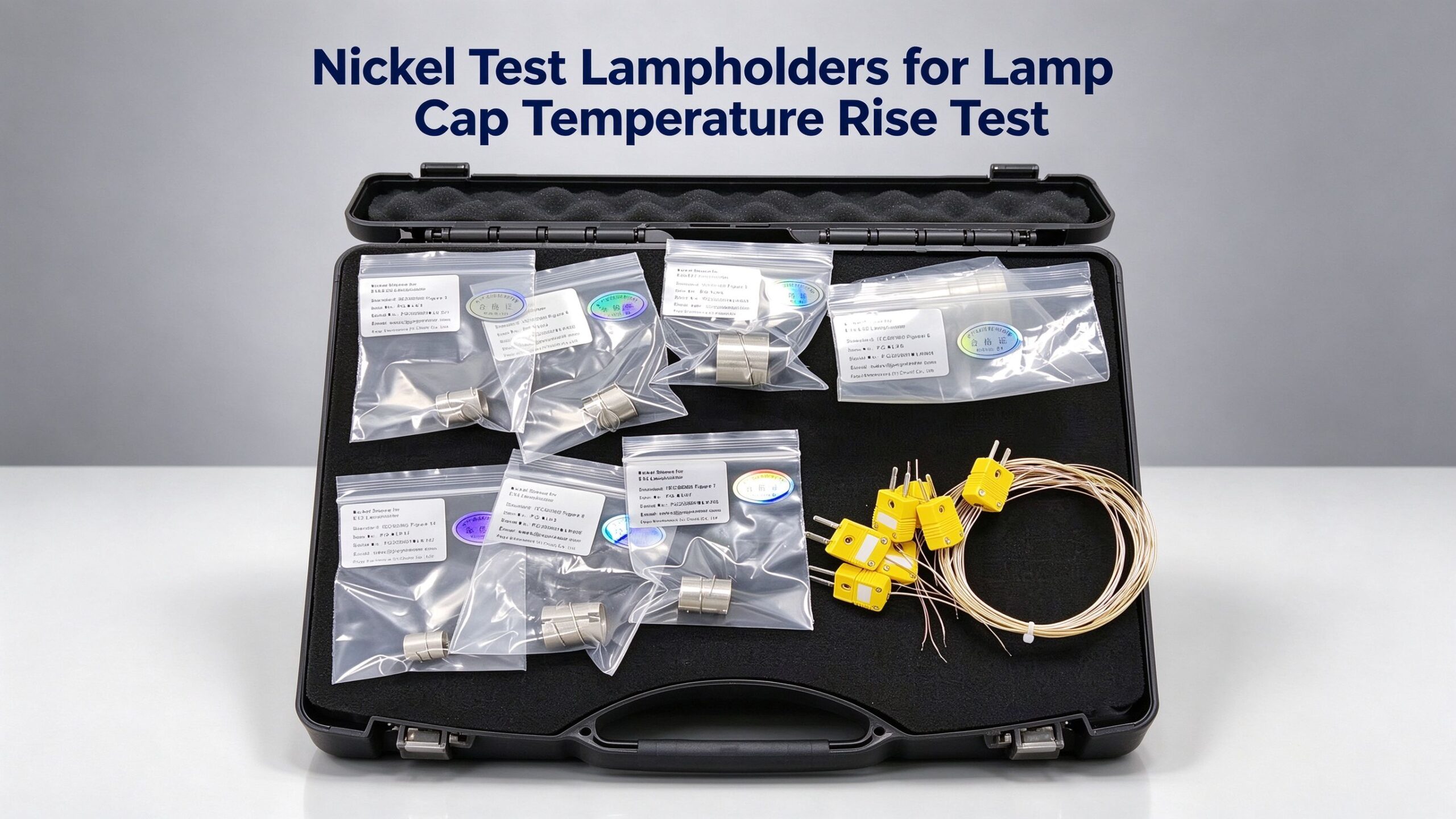
The standard test lampholder is a metal sleeve fitted with a thermocouple — commonly called a nickel test lampholder (or temperature rise sleeve). During testing, we slide the nickel sleeve over the lamp cap’s outer edge. We secure it with an spring steel wire loop to ensure good contact. The thermocouple attaches to the sleeve’s outer wall and sends the equilibrium temperature to the readout instrument.
Why must we use pure nickel? Nickel offers stable thermal conductivity and heat capacity. It transfers the cap temperature faithfully and evenly. It also resists corrosion and oxidation. This forms the basis for measurement repeatability. Wrong material choices make data unreliable.
4. Hard Criteria for a Qualified Nickel Lampholder
The standard sets clear constraints on material and dimensions. We check each item carefully before use:
- Material: Nickel content ≥ 99%.
- Grain size: Minimum ASTM 8; fine and uniform structure.
- Hardness: Vickers hardness 135 ± 15.
- Thickness: 0.5 mm ± 0.02 mm.
- Surface: Rolled into a smooth cylinder with a longitudinal slit. No bends, dents, inclusions, grease, or other defects.
- Spring steel wire: Diameter approx. 0.8 mm; wraps the sleeve 1 to 1.5 turns.
- Available sizes fit screw caps like E14, E17/E20, E26/26d/E27, E39, and bayonet caps like B15d, B22d.
5. Choose the Right Nickel Test Lampholder for Reliable Tests
The standard test lampholder looks like a small part, but it directly decides whether certification bodies accept your test data. Insufficient nickel content, hardness or thickness deviation, and surface defects all distort contact thermal resistance and temperature readings. This can even make a failed lamp “pass” the test.
When selecting a test lampholder, we focus on three things: material purity, hardness and thickness compliance; size match with your lamp cap type. Among lamp temperature rise test equipment, the test lampholder costs little but guards the credibility of your entire test. For size selection or sample comparison, feel free to contact us anytime.