In the production and manufacturing of lamps and similar electrical appliances, ensuring product safety and reliability is crucial. As a key component in lamps and other products, the torque strength of the screw gland directly affects the overall performance of the product. To accurately detect the torque strength of screw glands, the screw glands test device came into being. This paper focus on the screw glands torque test device, especially the PEGO PG-SGT screw glands torque test device. It elaborates on the relevant standards, usage, principles, structure and characteristics of the screw glands torque test apparatus.
1. Applicable Standards
The design and manufacture of the screw glands torque test device strictly comply with multiple national and international standards. These include Clause 24.6 of GB2099.1-2008, Clause 4.12.5 of GB 7000.1-2015 (Luminaires – Part 1: General Requirements and Tests), IEC60598.1:4.12.5, and Clause 24.6 of IEC884-1. These standards clearly specify the torque strength requirements for lamp screw glands. They ensure that products will not have safety hazards due to problems with screw glands in actual use.
2. Usage
This test device is mainly used to inspect the torque strength of screw glands in lamps and similar electrical appliances. By simulating the torque that may be borne in actual use, it evaluates the mechanical strength and fixing reliability of the screw glands. Whether it is a professional testing institution or the quality inspection department of lamp manufacturers, the screw glands torque test device is an important testing equipment to ensure product quality. It can help enterprises timely find problems in product design and production processes. This avoids unqualified products from entering the market and protects consumers’ safety in use.
3. Testing Principle
The testing principle of the screw glands torque test device is based on applying a certain torque to the gland and observing the state of the gland and its connectors. During specific operations, one end of the screw gland is fixed, and the other end is rotated with a torque wrench. A specific torque value is applied in accordance with relevant standards. In this process, it is judged whether the gland and its connectors are damaged according to the standards. If the gland and connectors are not damaged under the specified torque, such as no thread slipping or gland cracking, the torque strength of the threaded seal gland meets the requirements. Conversely, it indicates that there are quality problems with the product, requiring improvements in product design or production processes.
4. Structure and Characteristics
4.1 Structure
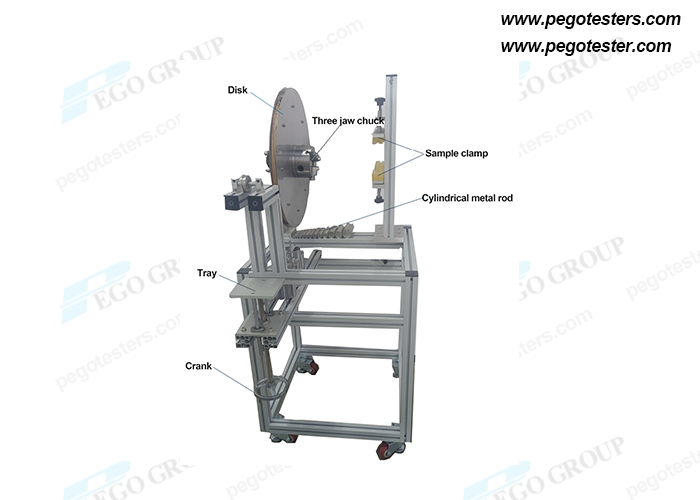
– Frame and Columns: The frame and columns are usually made of imported aluminum alloy profiles. This material not only makes the device look beautiful but also has excellent structural strength. It can stably support the entire test device, ensuring that the device will not deform due to force during the test, which would affect the accuracy of test results.
– Clamping and Positioning System: It adopts a three jaw chuck clamping and positioning method. This system can flexibly adapt to test lamps of different shapes and specifications. It greatly enhances the device’s applicability to various lamps and expands its application range. Whether it is a lamp with a conventional shape or a special structure, it can be accurately fixed through this clamping and positioning system for torque strength testing.
– Testing Components: It is generally equipped with stainless steel rods of different specifications. For example, there is one each of Ф5, Ф7, Ф9, Ф10, Ф12, Ф14, Ф16, Ф18, Ф20, Ф22, Ф25, Ф30, Ф32, Ф40mm. It also has weights of various specifications, such as one each of 20N, 40N, 50N and 60N weights. These stainless steel rods and weights can be combined according to the test requirements of different lamp screw glands to apply corresponding torque. At the same time, it is also equipped with a disc. The common disc diameter is 250mm, and the material is mostly steel. It plays a role in auxiliary support and positioning during the test.
4.2 Characteristics
– Manual Operation, Simple and Convenient: It adopts a manual testing method. Operators can directly control the torque application process and have a more intuitive feeling and grasp of the test situation. Compared with complex automated equipment, manual operation does not require complex programming and debugging. It reduces the technical threshold for operators. Even those using the device for the first time can master the test skillfully after simple training.
– Strong Applicability, Wide Application: With the three-dimensional space clamping and positioning system and rich testing components, it can meet the test requirements of most lamp screw glands. Whether it is a small household lamp or a large industrial lighting lamp, accurate torque strength testing can be carried out on this test device. This makes the device have wide application value in lamp manufacturers, quality inspection institutions, and related scientific research units.
The screw glands torque test device plays an indispensable role in the quality inspection of lamps and similar electrical products. By strictly following relevant standards in design and manufacture, with its unique testing principle, reasonable structural design, and rich technical parameters, it can efficiently and accurately detect the torque strength of threaded seal glands. It provides strong support for ensuring product quality and consumer safety.