For a washing machine, every opening and closing of the door is a silent test of quality and safety. From the high-frequency use of daily laundry to the wear and tear of long-term service, the durability of the washing machine door directly impacts user safety, experience, and brand reputation. Data shows that door failures—including seal failure, latch malfunction, and hinge damage—account for over 15% of washing machine after-sales complaints.
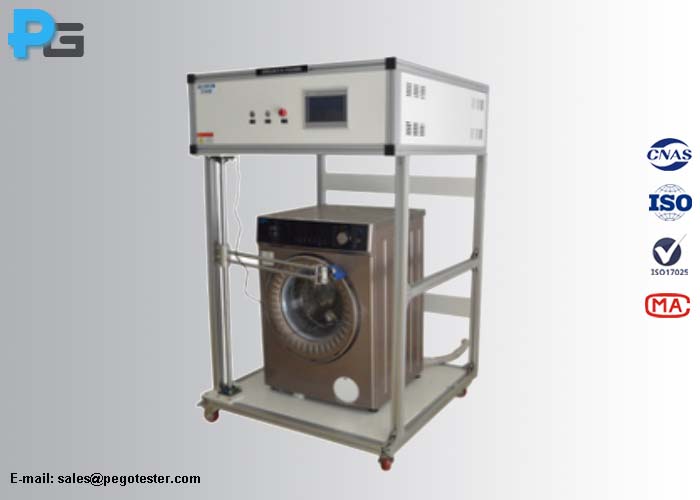
To help enterprises avoid quality risks at the source and precisely meet international market access requirements, a Washing Machine Door Endurance Tester was developed. It strictly adheres to IEC 60335-2-7 clauses 18.101 and 22.104, IEC 60335-2-11 clause 20.101, and IEC 60335-2-4 clause 18. It builds a solid foundation for quality through scientific testing principles and empowers industry upgrading with professional testing capabilities.
Deep Dive: Unlocking the Scientific Logic
The core principle of the washing machine door durability test lies in accurately simulating real usage scenarios. It subjects the door and interlock device to long-term cyclic opening and closing tests to quantify their mechanical lifespan and reliability boundaries.
This tester perfectly replicates this logic. It adopts a PLC + servo motor control system, paired with a mechanical arm and vacuum suction cup fixture. It can precisely reproduce the force, angle, and speed of a human hand opening and closing the door. The adjustable angle range covers 0-180° for side doors and 30-90° for top doors. With a high-frequency rate of 30 cycles per minute, it can cover extreme scenarios across different models and usage habits.
During testing, the equipment forms a closed-loop control through a precision force sensor mounted on the mechanical arm and the servo system. It monitors the door-closing force in real-time. At the same time, it conducts power-on and power-off cycle tests on the interlock device. This completely restores the full process of “Power On – Power Off – Open Door – Close Door.” It thereby verifies the performance stability of key components such as hinges, latches, and door seals under long-term fatigue.
Value Proposition: Why Durability Testing is Critical
Amidst consumption upgrading and global competition, the significance of washing machine door durability testing has gone beyond basic inspection to become a key pillar of a company’s core competitiveness.
From a safety perspective, durability testing that complies with IEC standards effectively verifies the reliability of the door lock interlock. It prevents safety accidents such as water leakage or clothes being thrown out due to accidental door opening during high-speed operation, thus safeguarding user safety.
From a quality perspective, tens of thousands of cycles of testing can expose issues such as material fatigue and structural design flaws in advance.
Core Strengths: The Four Competitive Advantages
As a “right-hand man” for quality control, this Washing Machine Door Endurance Tester has become the preferred equipment for home appliance enterprises, quality inspection institutions, and R&D centers due to its precision, efficiency, versatility, and intelligence.
First, full compliance with standards. It is designed in strict accordance with core IEC clauses. The test procedures and parameters fully match international requirements, meeting global testing needs without additional adaptation.
Second, high customization support. For different models such as top-load and front-load washers, mechanical arms can be specially developed to fit left-opening, right-opening, and top-opening doors. Combined with vacuum suction cups and universal fixtures, it accurately meets diverse testing needs.
Third, high intelligence. It features a TFT true-color LCD touch screen. It supports visual setting of parameters such as test cycles (0-999,999 times adjustable), angle and speed. It also has real-time data recording, fault alarm, and power-off resume functions. This enables 24-hour unmanned testing, improving efficiency by 8 times compared to traditional manual testing.
Fourth, stable and reliable structure. The frame uses high-grade aluminum profiles. The mechanical arm is made of high-strength stainless steel, driven by servo motors. This ensures precision and stability during long-term high-frequency testing, with a door opening angle error of ≤±1° and a counting error of 0%.
Conclusion
In the home appliance industry’s pursuit of high quality and reliability, a professional testing device that meets international standards is the “confidence” for enterprises to cope with market competition.
Based on scientific principles, centered on strict standard compliance, and targeting comprehensive quality assurance, this Washing Machine Door Endurance Tester serves as the “Quality Gatekeeper” guarding the durability of washing machine doors. Whether it is to enhance product competitiveness, reduce after-sales costs, break through international market barriers, or build brand reputation, it is an indispensable core testing equipment for home appliance enterprises.