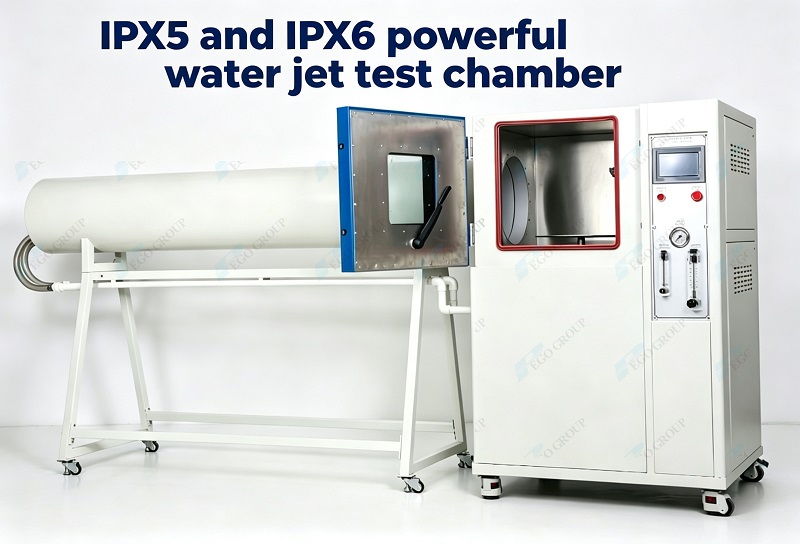
A street lamp will stand on an outdoor pole. A charging pile will sit in an open-air parking lot. A power tool will face high-pressure washing on a rainy construction site. Whether a product survives strong water impact decides its service life and reputation in real use. Every such product must pass the IPX5 or IPX6 powerful water jet tests before leaving the factory.
1. What Are IPX5 and IPX6 Based On?
The IP (Ingress Protection) rating follows IEC 60529, the international standard set by the International Electrotechnical Commission. China’s corresponding standard is GB/T 4208-2017, titled “Degrees of Protection Provided by Enclosures (IP Code)”. Luminaires must also meet the requirements of GB 7000.1.
The IP code contains the letters “IP” plus two digits. The first digit shows the protection level against solid foreign objects (dust). The second digit shows the protection level against water. In IPX5 and IPX6, “X” means the first digit does not apply. The digits 5 and 6 represent two progressive water protection levels — the higher the number, the stronger the protection. Both levels belong to the “water jet” family. Yet their test conditions differ greatly. One is a water jet test; the other is a powerful water jet test.
2. Definitions of the IPX5 and IPX6 Tests
According to Clause 14.2.5 of IEC 60529, the IPX5 test sprays water onto the enclosure from any direction through a Φ6.3mm nozzle. IPX5 simulates close-range rinsing with a medium-strength water flow.
According to Clause 14.2.6 of IEC 60529, the IPX6 test sprays the enclosure with a powerful water jet from any direction through a Φ12.5mm nozzle. IPX6 delivers 8 times the flow rate of IPX5 and roughly 3 times the water pressure. It simulates harsher conditions, such as heavy wave impact and high-pressure cleaning.
The detail test condition as below:
| Item | IPX5 | IPX6 |
| Test name | Water jet test | Powerful water jet test |
| Nozzle diameter | 6.3 mm | 12.5 mm |
| Water flow rate | 12.5 L/min (±5%) | 100 L/min (±5%) |
| Water pressure at nozzle outlet | approx. 30 kPa | approx. 100 kPa |
| Spraying distance | 2.5 m – 3 m | 2.5 m – 3 m |
| Test duration | ≥3 min (1 min/m²) | ≥3 min (1 min/m²) |
| Simulated scenarios | Hose rinsing, medium water flow | Heavy waves, high-pressure cleaning |
3. Why Choose a Chamber-Type Powerful Water Jet Test Equipment?
To perform IPX5 / IPX6 tests, the market offers two equipment types: open-type test setups and chamber-type powerful water jet test equipment. For most manufacturers, the chamber type is the first choice. Here are five reasons.
1). Water recycling cuts operating costs. An open-type setup needs a continuous water supply and drains wastewater directly. It consumes thousands of liters per hour and requires a large water tank plus drainage facilities. A chamber-type machine builds in a stainless steel water tank and a circulating filtration system. It recovers, filters and reuses the test water, so it needs very little top-up. This saves significantly on water bills and environmental treatment costs in the long run.
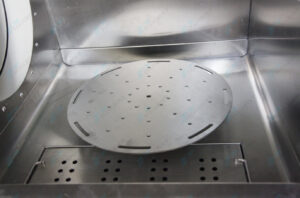
2). Standardized jet conditions ensure repeatable results. The standard sets strict requirements on flow rate, pressure, distance and angle. An open-type setup usually relies on an operator holding the nozzle by hand. Distance and angle become hard to control, so results vary from person to person. A chamber-type machine fixes the nozzle at a designated position inside the chamber. A variable-frequency pump and sensors regulate the flow and pressure in a closed loop. One-touch start delivers a stable, standard-compliant water flow. The same product gives consistent results in repeated tests, and all test data stays traceable.
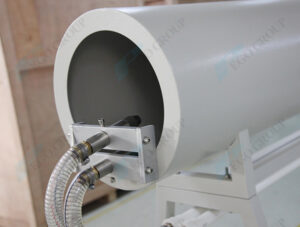
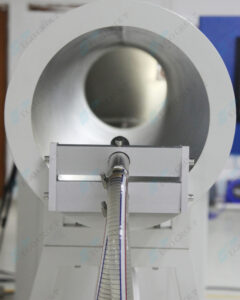
3). Safe, clean and splash-free. The IPX6 test delivers a powerful 100 L/min jet. An open-type test site splashes water everywhere and leaves the floor wet, creating safety hazards. In a chamber-type machine, the water flow stays fully enclosed. An observation window and a safety door allow operators to watch the test without facing the high-pressure jet. The working area remains clean and safe.
4). Compact footprint and easy installation. An open-type setup must reserve at least 3 meters of spraying distance plus drainage area. It occupies a large space and demands a lot from the site. A chamber-type equipmentcompresses the whole spraying space into the chamber. One unit completes the entire test. The factory only needs standard power and water supply to put it into use.
Of course, the chamber type has its limits. When a sample is too large or too heavy, an open-type setup becomes the required choice.
4. Suitable Products and Application Scenarios
A chamber-type powerful water jet test equipment suits any product that must verify its resistance to strong water jets:
- Outdoor lighting: street lights, garden lights, floodlights, tunnel lights
- New energy: charging piles, PV modules, energy storage cabinets
- Automotive electronics: headlights, sensors, rearview mirrors, on-board controllers
- Outdoor appliances: power tools, garden machinery, portable power stations
- Consumer electronics: waterproof phones, outdoor speakers, action cameras
- Industrial equipment: outdoor cabinets, distribution boxes, surveillance cameras
5. Conclusion
A waterproof rating is not a marketing slogan. It is a quantifiable test standard. Choose a powerful water jet test chamber that complies with IEC 60529. You then build a controllable, repeatable and traceable line of defense before shipment.