Outdoor equipment is vulnerable to water. Whether it’s streetlights, charging stations, utility meter boxes, or rooftop photovoltaic junction boxes, if water manages to seep through any gaps during a heavy downpour, the result can range from a tripped circuit breaker to a fire. To determine whether an enclosure can withstand rain, engineers look at the two digits that define its ingress protection (IP) rating—specifically, IPX3 and IPX4.
Spraying and splashing: the difference sits in the angle
IPX3 covers “spraying water.” Drops fall in sheets from above and from a slant, much like moderate to heavy rain. IPX4 covers “splashing water.” Water hits from any direction, and it brings the rebound: the splash that bounces back off the ground, like a downpour hammering concrete, or a hose washing a floor.
The distinction lies in the angle, not the volume of water. IPX3 only requires protection against water arriving within a 120° arc (60° to either side of the vertical), whereas IPX4 extends this range to 180° on each side—covering a full 360°. Consequently, the coverage area for IPX4 completely encompasses that of IPX3.
The oscillating tube: a shower head that travels
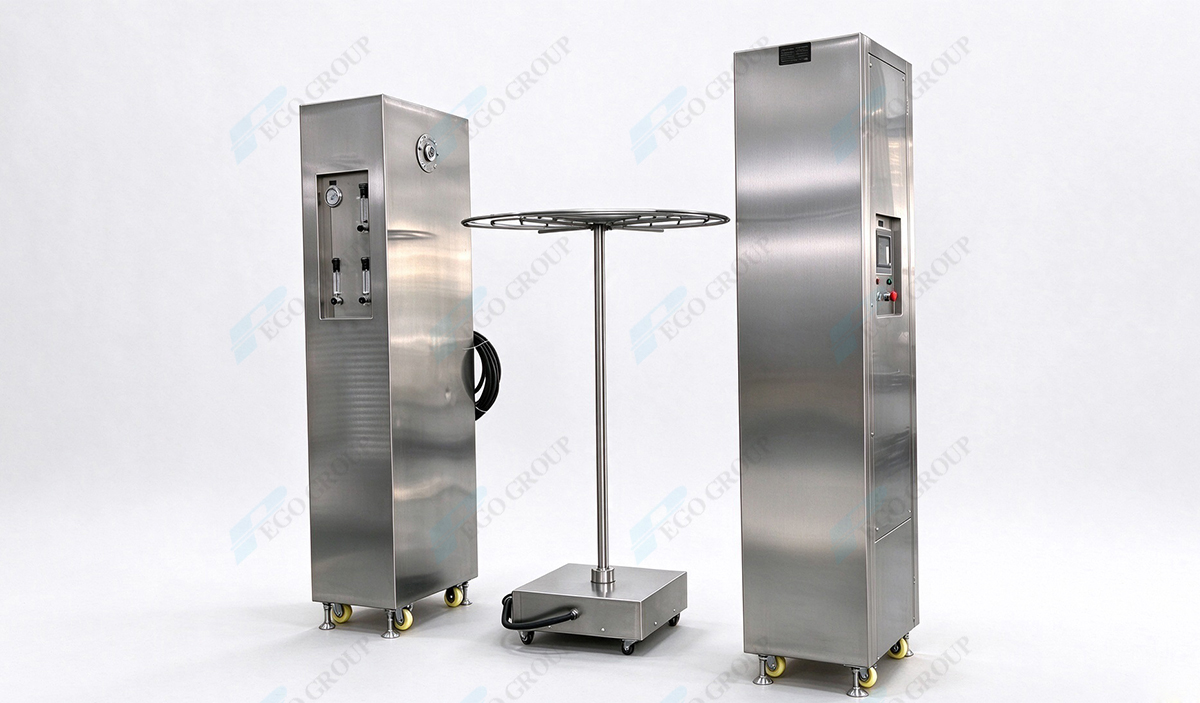
The oscillating tube is a half-circle pipe, 180 degrees, with a row of small holes drilled along the arc. Each hole measures 0.4 mm, sits 50 mm from its neighbour, and points inward. During testing, the sample is placed at the center of an arc, along which a pipe swings back and forth within a vertical plane. Water sprays from holes in the pipe—much like a rotating showerhead—sweeping over the sample from top to bottom.
The parameters are straightforward. Each hole delivers 0.07 liters of water per minute, and the entire test lasts for 10 minutes. For IPX3, the spray tube oscillates 60° to either side, with an oscillation speed of 2×120°/min; for IPX4, the range is extended to 180° on each side, with an oscillation speed of 2×360°/min. The angle is tripled, ensuring more comprehensive coverage and a faster oscillation rate.
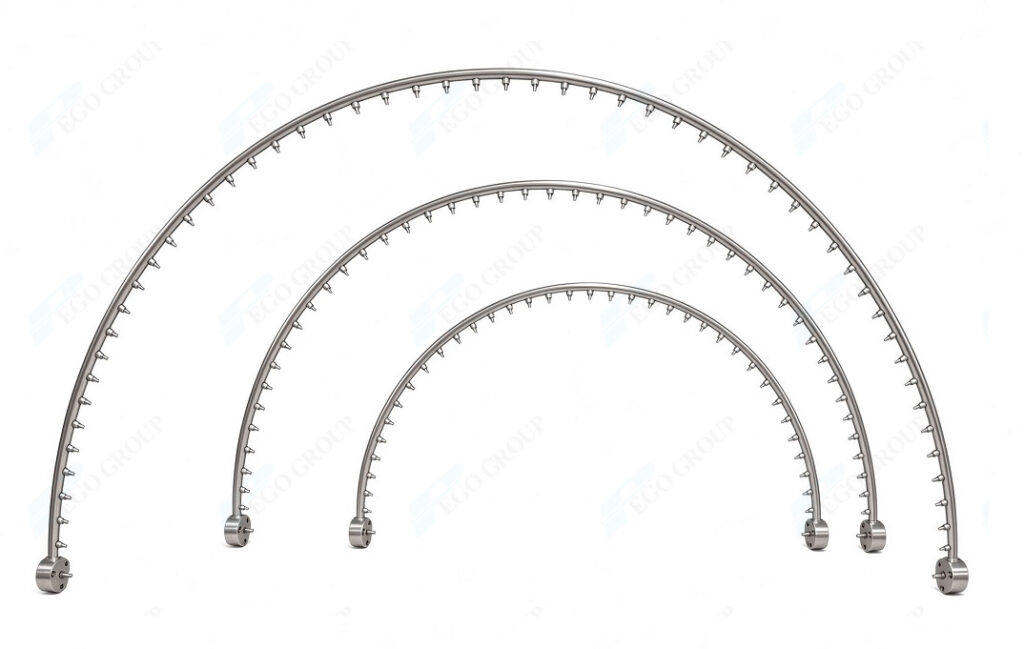
Four conditions that tell you to use the tube
First, the sample must fit inside the apparatus with some room to spare. There is a specific geometric threshold for this: the radius of the oscillating tube minus the radius of the sample’s circumscribed circle must not exceed 200 mm. Beyond this distance, the water spray disperses, leading to uneven coverage. Therefore, one must select an oscillating tube size that “just barely encompasses” the sample; standard radii typically range from 200 mm to 1600 mm.
Second, the results must be verifiable and accepted by others. Whether for formal type-testing at a certified laboratory, providing reports to clients, or conducting batch sampling, the process requires a set of predefined, reproducible conditions—such as oscillation amplitude, speed, flow rate, and duration—that can be recorded, audited, and replicated. In contrast, manual spraying with a handheld spray nozzle—where the angle and distance vary with each attempt—yields inconsistent data that cannot be reliably compared.
Third, the enclosure may have multiple points of water ingress. For instance, a housing might feature screw holes on the top, cooling vents on the sides, and cable outlets at the bottom. An oscillating tube can cover the top and slanted surfaces in a single rotation, whereas manual spraying is prone to missing certain areas—often the very spots where water is most likely to enter.
Fourth, when dealing with a large number of small or irregularly shaped items—such as junction boxes, sensors, lighting fixtures, photovoltaic connectors, or compact power supplies—manual spraying is highly inefficient. Placing these items on a test rack and running the apparatus for ten minutes saves both labor and time.
When to give up and switch methods
If a sample’s dimensions exceed the capacity of an oscillating tube—such as in the case of large outdoor cabinets, energy storage containers, or extra-long fluorescent tubes—using an oscillating tube is geometrically impossible. The standards provide an alternative: for IPX3 and IPX4, handheld spray nozzle may be used instead. In such cases, the deviation from the standard method should simply be noted in the test report. The same alternative approach applies when a piece of equipment cannot be moved into the testing facility and must be tested on-site.
Another common point of confusion involves IPX5 and IPX6, which are water-jetting tests. These utilize 6.3 mm or 12.5 mm nozzles with flow rates of 12.5 L/min or 100 L/min, respectively—processes entirely unrelated to oscillating tubes. Be careful not to conflate these two types of tests.One more thing that people confuse: IPX5 and IPX6 are jet tests. They use a 6.3 mm or 12.5 mm nozzle at 12.5 litres or 100 litres per minute, and they have nothing to do with the oscillating tube. Keep the two families apart.
The two aspects most prone to error
The first is the installation orientation. The sample must be positioned exactly as it is intended to function during normal operation—ensuring that the side meant to face upward is oriented correctly, and that seals are subjected to the appropriate load. Placing the sample on its side or in any other orientation simply for the sake of easier installation will render the test results invalid.
The second is the flow rate. Before testing, the flow rate must be calibrated and the water pressure stabilized—and these conditions must be maintained consistently for 10 minutes. If this step is skipped, all the carefully configured parameters established beforehand become meaningless.
In short: Use an oscillating tube if the specimen fits, the surrounding clearance is no more than 200 mm, and you require uniform, reproducible, omnidirectional water spraying. Otherwise—if the specimen is too large or testing must be conducted on-site—resort to the handheld device permitted by the standard.
| Item | IPX3 | IPX4 |
| Swing angle | 60° either side, 120° total | 180° either side, 360° total |
| Swing rate | 2 × 120°/min | 2 × 360°/min |
| Duration | 10 min | 10 min |
| Flow per hole | 0.07 L/min | 0.07 L/min |
| Hole size and spacing | 0.4 mm, 50 mm | 0.4 mm, 50 mm |
| Geometric requirement | Tube radius minus sample outer radius ≤ 200 mm | Same |