1. Introduction
In the ingress protection (IP) system, the second characteristic numeral shows how well an enclosure resists water. IPX3 protects against spraying water. IPX4 protects against splashing water. These are the two most common water ratings. They apply to outdoor luminaires, cabinets, charging stations, and instruments. Many electrical devices installed outdoors use these ratings.
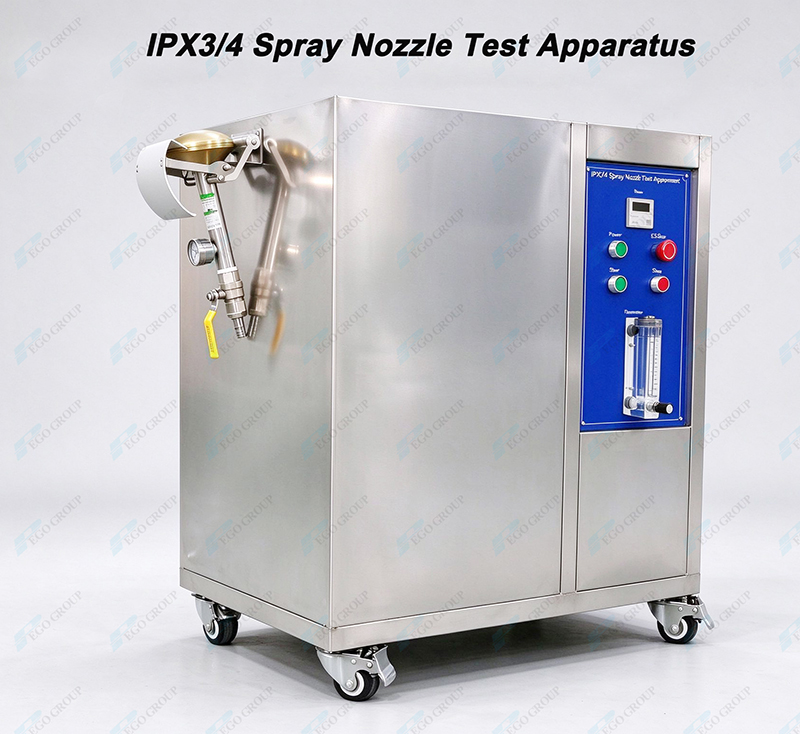
Per IEC 60529:2013, Clauses 14.2.3 and 14.2.4, IPX3 and IPX4 tests each permit one of two devices: the oscillating tube (Figure 4) or the hand-held spray nozzle (Figure 5). This article explains when use the spray nozzle for IPX3 and IPX4 testing.
2. Structure and Standard Basis
The spray nozzle is a hand-held water spray device. It has three main features:
- Its nozzle face is a circular plane of Φ100 mm.
- It contains 121 spray holes of Φ0.5 mm, evenly distributed.
- It comes with a flexible hose. This lets the operator walk around the specimen and spray from all directions.
- It has a removable baffle. The baffle switches between IPX3 and IPX4 modes.
Its standard basis includes Clauses 14.2.3 b), 14.2.4 b) and Figure 5 of IEC60529. The standard requires to adjust the water pressure within 50 kPa to 150 kPa to obtain the specified discharge. The pressure must remain constant during the test.
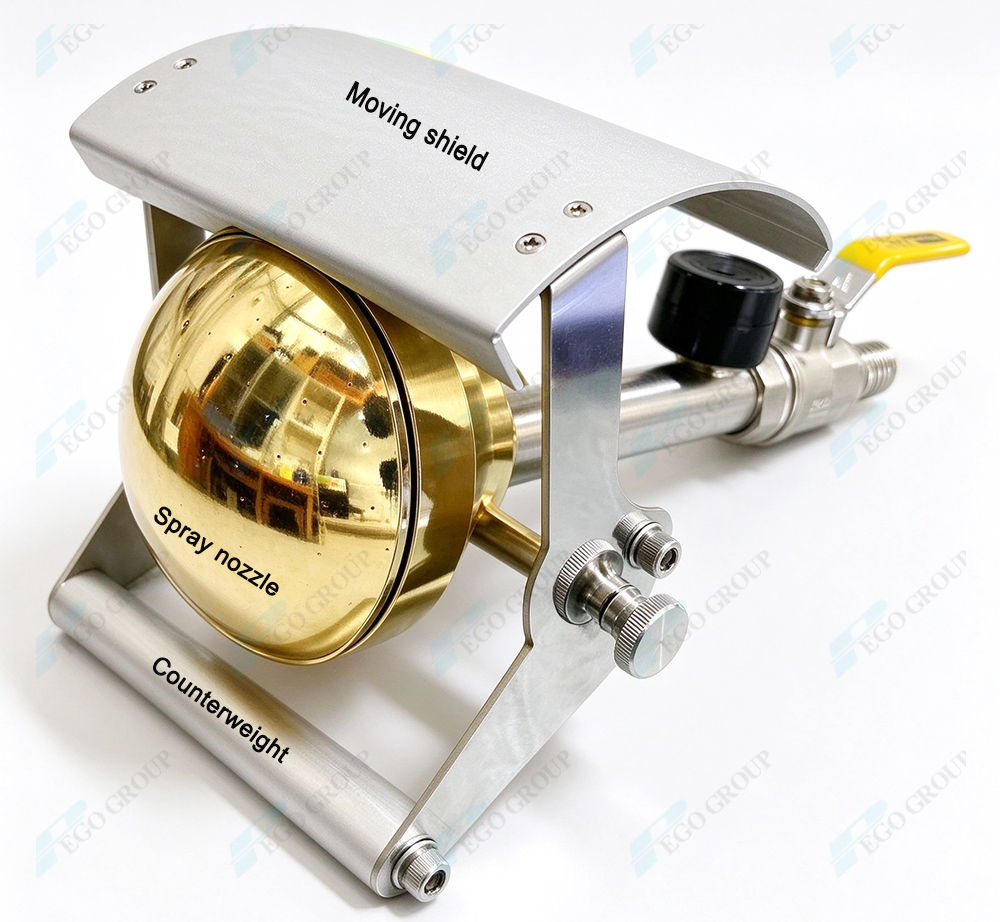
3. When to Use the Spray Nozzle
An oscillating tube apparatus is the preferred choice. However, when such an apparatus cannot meet the test requirements, a spray nozzle is used instead. Specifically, this applies in the following scenarios:
3.1 The oscillating tube cannot wet the entire enclosure surface
The maximum allowable radius of the oscillating pipe is 1600mm, and the spray coverage is limited. When the size of the test sample is too large, the shape is irregular, and there are spray dead corners, resulting in the inability of all surfaces of the shell to be wetted, the standard clearly requires in Article 14.2.3 a): “In this case, priority should be given to using the handheld test equipment (spray nozzle) shown in Figure 5.”
3.2 Large, heavy, or permanently installed equipment
For items such as cabinets, outdoor lighting fixtures, charging piles, or equipment that is wall-mounted or suspended—where the test specimen is too large or heavy, or already fixed in its final installation position—it is impossible to place the unit on a rotating platform or rotate it for oscillating tube spray testing. In such cases, a handheld spray nozzle—offering flexible operation and the ability to spray the specimen from all directions—becomes the only viable, compliant testing solution.
3.3 Specified in Relevant Product Standards
Test methods shall be carried out in accordance with the provisions of the relevant product standards. When a specific product standard mandates the use of the water spray nozzle shown in Figure 5, that standard shall be followed, and an oscillating tube shall not be used as a substitute.
3.4 Irregularly Shaped Test Specimens with Hidden Areas
For specimens with complex, non-standard outer casings or internal structures that prevent the oscillating tube from reaching certain areas, the spray nozzle allows for manual adjustment of the spray angle and position, ensuring that all surfaces are evenly exposed to the water.
4. Differences Between IPX3 and IPX4
Both tests use the same spray nozzle. The only difference lies in the shield and the spray coverage:
| Item | IPX3 (Spraying water) | IPX4 (Splashing water) |
| Baffle | Retained (with counterweight) | Removed |
| Spray range | 60° on each side of the vertical, 120° in total | 180° on each side of the vertical, 360° all directions |
| Protection meaning | Protects against rain within a limited angle | Protects against splashing water from any direction |
For IPX3, a shield is used to restrict water spraying to a sector within ±60° from the vertical, simulating natural rainfall. For IPX4, the shield is removed, allowing the enclosure to be subjected to splashing water from any possible direction.
5. Key Test Parameters
| Parameter | Specified Value |
| Nozzle head | Φ100 mm circular face, 121 holes × Φ0.5 mm |
| Water pressure | 50–150 kPa (adjust to reach the specified flow) |
| Total flow rate | Approx. 10 L/min (±5%) |
| Nozzle-to-specimen distance | Approx. 300–500 mm |
| Test duration | 1 min/m² of enclosure surface (excluding mounting surface), minimum 5 min |
| Water quality | Clean water; water temperature within 5 K of the specimen |
During the test, the operator shall hold the spray nozzle and move it at a uniform angular velocity of approximately 60°/s, ensuring that the top and vertical surfaces of the test specimen are evenly exposed to water within the specified angular range. For large-scale equipment, the spraying may be conducted in sections or stages to ensure that each surface is subjected to water for the required duration.
6. Test Precautions
1). Flow-Priority, Pressure-Secondary Approach: The primary objective is to achieve the specified flow rate, which is regulated by adjusting the water pressure. Flow meters and pressure gauges must be calibrated periodically (typically every 6 months).
2). Temperature Control: The temperature difference between the water and the test specimen must not exceed 5K to prevent thermal shock or condensation, which could lead to erroneous test results. Care should be taken to ensure that accumulated condensation is not misidentified as water ingress.
3). Surface Area Calculation: The calculated surface area of the enclosure—excluding the mounting surface—must have an error margin of no more than 10%.
4). Acceptance Criteria: Whether a specimen is deemed to have passed the test depends on whether any water ingress impairs the normal operation or safety of the equipment. Specific acceptance criteria are defined by the relevant product standards.
5). Maintenance: After testing, the spray nozzles should be rinsed with clean water. Any blockages in the Φ0.5 mm orifices should be cleared using compressed air or a fine needle to ensure the accuracy of the flow rate.
7. Conclusion
The spray nozzle apparatus is not a distinct category separate from the IPX3 and IPX4 ratings. Rather, it serves as an alternative spraying device available for both. It is primarily intended for scenarios where an oscillating tube cannot provide full coverage—such as with large, heavy, or irregularly shaped equipment, permanently installed units, or cases where an oscillating tube fails to wet the entire surface of the test specimen. Its use is also mandatory when explicitly required by relevant product standards. When the handheld spray nozzle is employed, the only differences between IPX3 and IPX4 lie in the presence or absence of a shield and the spray coverage (120° versus 360°); all other technical parameters remain identical. Understanding the conditions under which the handheld spray nozzle apparatus should be used provides essential engineering guidance for ensuring compliance during ingress protection (IP) testing and for selecting appropriate test equipment.