During the research, production and testing of electrical equipment, there is a device that seems unremarkable but is extremely important. It simulates the actual working environment of equipment and protects the safety of every product. This device is the temperature rise test corner. Whether it is household appliances we use every day or power equipment in industry, the key evaluation of their thermal performance all depends on accurate testing with a temperature rise test corner.
1. What is a temperature rise test corner?
A temperature rise test corner is a special testing device that simulates the actual operating environment of electrical equipment. Its main job is to measure the temperature rise of key components when the equipment runs under normal or abnormal conditions, and check whether its heating performance meets safety standards.
Simply put, electrical equipment produces heat when it works. If the heat cannot be released in time, the temperature of components will keep rising. This may speed up equipment aging, shorten service life, and even cause overheated casings, damaged insulation, fires, electric shocks and other serious safety accidents.
The main purpose of a test corner is to simulate the worst working conditions of equipment, such as placing it against a wall or in a corner, to accurately measure temperature changes and check whether the heat dissipation of the equipment is acceptable.
2. Production standards and structure of test corners
As a standardized testing device, the design and structure of temperature rise test corners strictly follow international and national standards. The most important one is Chapter 11 “Heating” in IEC 60335-1, and it is referenced by many product standards. Its structure looks simple but includes many detailed designs to ensure accurate and reliable test results.
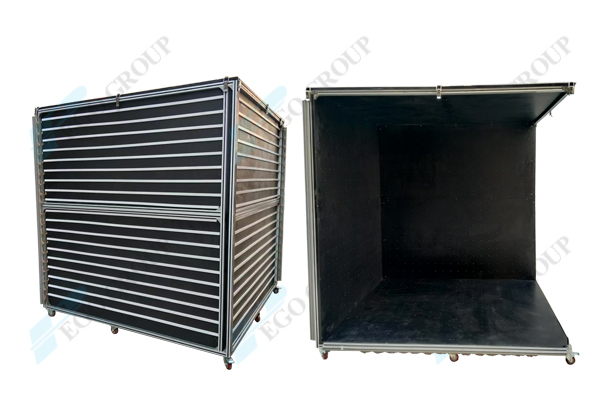
A test corner mainly consists of a main frame, temperature measurement parts and auxiliary accessories.
The main frame usually includes two vertical boards and one horizontal base board, forming an internal angle of 90°±1°. This perfectly simulates the corner of a wall and the floor in homes or factories. The gap inside the angle is controlled within 1mm and sealed to prevent air flow from affecting test results.
The frame is made of 20mm-thick plywood with a thermal conductivity of about 0.1W/(m·K). Its surface is painted with matte black paint to copy the heat absorption and release of real walls and floors, and avoid inaccurate temperature readings caused by fast heat conduction or reflection. For wall-mounted or built-in products, a top cover can be added. The distance between the cover and the top of the product must be 150mm±10mm.
The temperature measurement assembly is the core sensing part of the test corner and directly affects the accuracy of test data. According to standards, it uses K-type thermocouples with a wire diameter of ≤0.3mm, matched with 15mm×1mm black-painted brass sheets. The thermocouple is attached to the back of the brass sheet, which is level with the surface of the test corner to reduce measurement errors and accurately record surface temperature changes.
Temperature measuring points are arranged in a 100mm×100mm matrix on the vertical and bottom surfaces, usually 81 points on each surface, forming a complete temperature monitoring system to fully record the temperature distribution. All thermocouples are connected to a terminal block for easy connection with external temperature measuring instruments.
The size of the test corner can be adjusted according to the equipment being tested. The standard size is 1000×1000×2000mm for most household appliances. Larger sizes such as 1500×1500×2500mm are used for big equipment, while small sizes like 800×800×1000mm and 1000×1000×1000mm meet different testing needs. Four movable wheels are installed at the bottom for easy movement in the laboratory.
3. Working principle of temperature rise test corners
The working principle of a test corner is a closed process: simulate the environment, measure temperature accurately, and compare data.
During testing, the equipment under test is placed in the test corner in its normal working position. Floor-standing equipment is placed on the base board, desktop equipment directly on the surface, and wall-mounted equipment fixed with brackets. The distance between the equipment and the two vertical boards and the base board is kept at 150mm±10mm to ensure correct heat dissipation simulation.
The laboratory temperature is controlled at 23℃±2℃ (or 20℃±5℃ for special cases), with no forced air flow or other heat sources to copy real working conditions.
The equipment is connected to rated power and runs until it reaches a stable working state, usually when the temperature change is ≤2℃ within 3 hours. During the test, a temperature recorder collects temperatures of key parts such as the casing, windings, terminals and power cords. The readings are then compared with standard limits to judge whether the equipment is qualified. If the temperature rise exceeds the standard, the product fails the test and needs improved heat dissipation design before retesting.
4. Applications of temperature rise test corners
Temperature rise test corners are widely used in many fields and play a key role in ensuring product safety.
In household appliances, products such as microwave ovens, electric ovens, air conditioners, refrigerators and heaters must pass temperature rise tests to get national certification and enter the market. This prevents overheated casings and damaged parts and keeps families safe.
In industry, temperature rise test corners evaluate the heat dissipation of transformers, cables, switches and other power equipment during long-term full-load operation, avoiding power failures and keeping production stable.
In medical treatment, patient monitors, ultrasound machines and other devices are tested with special temperature rise test corners to ensure working temperature does not affect accuracy and prevent burns to medical staff and patients.
IT equipment such as computers and servers also use temperature rise test corners to improve heat dissipation design and ensure stable long-term operation.
With the development of the electrical equipment industry and more types of products, heat dissipation design has become more important, making temperature rise test corners even more valuable. They are not only a pass for products to enter the market legally, but also an important tool for companies to improve product design and quality.