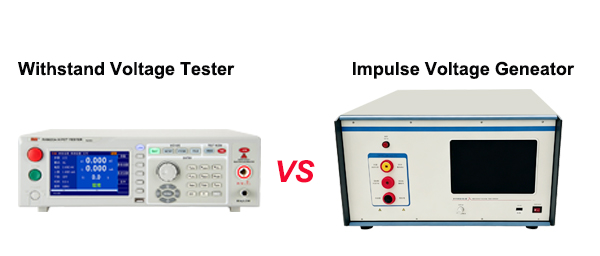
Both withstand voltage test and impulse withstand voltage test are core items for electrical insulation safety evaluation. However, they differ significantly in testing principle, voltage waveform, application duration, and applicable scenarios. The withstand voltage test verifies the safety margin of insulation under long-term steady-state high voltage, while the impulse withstand voltage test evaluates the ability of insulation to resist transient overvoltage shocks. The two tests cannot replace each other.
1. Basic Definitions and Test Purposes
Withstand Voltage Test (Power Frequency / DC Withstand)
A continuous high voltage is applied between live parts and the grounded enclosure or housing to check for insulation breakdown, flashover, or excessive leakage current. It ensures electrical safety under normal operation and short-term overvoltage conditions.
- Purpose: Detect insulation defects, poor assembly, moisture ingress, aging, and verify steady-state insulation reliability.
Impulse Withstand Voltage Test (Lightning / Switching Impulse)
High-voltage pulses in the microsecond range are generated by an impulse voltage generator to simulate transient overvoltages caused by lightning strikes or switching operations. It evaluates the ability of the insulation system to withstand steep-front surge voltages.
- Purpose: Verify insulation safety under extreme overvoltages and assess the quality of insulation coordination and lightning protection design.
2. Comparison of Key Parameters
| Item | Withstand Voltage Test | Impulse Withstand Voltage Test |
| Voltage Waveform | Power frequency sine wave or stable DC voltage | Standard lightning wave 1.2/50μs, switching impulse waveform |
| Application Duration | Seconds to minutes (typically 10s or 60s) | Microsecond level; a single impulse lasts only tens of microseconds |
| Voltage Level | Several times the rated voltage, usually kV level | Higher amplitude, typically specified values for high-voltage equipment |
| Application Method | Continuous and stable voltage application | Single or multiple pulse impulses |
| Judgment Criteria | No breakdown, no flashover, leakage current within limits | No breakdown, no destructive flashover, insulation performance recoverable |
| Test Equipment | Withstand voltage tester | Impulse voltage generator |
| Test Nature | Routine test and outgoing inspection mainly | Type test, mandatory for high-voltage electrical equipment |
3. Differences in Principle and Characteristics
The withstand voltage test features a uniform electric field and long-duration stress, closely matching the actual power-frequency operating conditions of equipment. It effectively exposes overall insulation defects. Due to the long voltage application time, it involves certain thermal effects and belongs to a steady-state evaluation test for insulation.
The impulse withstand voltage test has a steep wavefront and extremely short action time, with negligible thermal effects. It mainly involves electric field stress breakdown and is more sensitive to local tiny defects, tip discharge, and air gaps. It represents an impact evaluation test under extreme working conditions.
4. Applicable Products and Scenarios
Withstand Voltage Test
Mandatory for safety certification of most electrical products, including household appliances, power tools, power adapters, lighting equipment, low-voltage electrical apparatus, motors, and cables.
Impulse Withstand Voltage Test
Used for transformers, switchgears, insulators, high-voltage cables, surge arresters, PV inverters, outdoor electrical equipment, and power system installations.
5. Relevant Standards
- Withstand Voltage Test: IEC 60950, IEC 60335, GB 4706, UL 60950 and other safety standards
- Impulse Withstand Voltage Test:IEC60225-5, IEC60335-1, IEC 60060-1, GB/T 3048.13, IEEE 4 and other high-voltage test standards
6. Conclusion
The withstand voltage test ensures long-term insulation safety under normal operating voltages, while the impulse withstand voltage test addresses extreme transient threats such as lightning and switching surges. The two tests have different objectives and evaluation focuses and cannot be substituted for each other. In product design and certification testing, they should be reasonably combined according to voltage level, application environment, and standard requirements to form a complete insulation safety verification system.