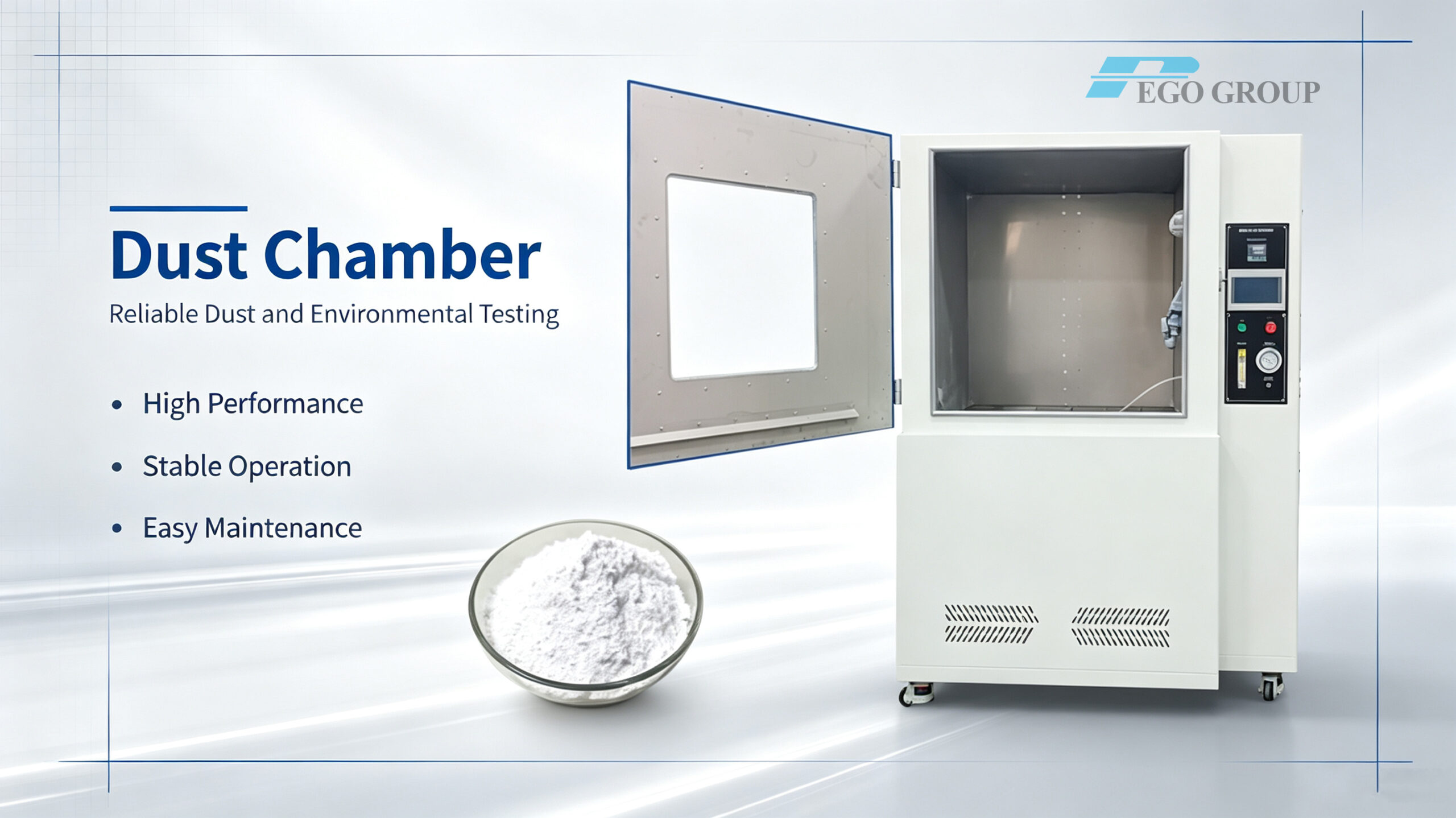
In the fields of electrical and electronic engineering, intelligent equipment, new energy, outdoor security and other industries, the IP5X/IP6X dust-proof protection grade of equipment enclosures serves as a core indicator for evaluating product environmental reliability, as well as a key compliance basis for market access testing, quality certification and type inspection. Specifically, IP5X is a limited dust-proof grade, which allows a small amount of dust to enter the equipment without impairing normal operation and safety performance. IP6X is a full dust-proof grade that requires zero dust ingress into the equipment, with a substantial difference in test stringency between the two grades.
The accuracy and compliance of dust test results depend not only on test parameters such as wind speed, dust concentration, test duration and negative pressure environment, but also on the type, composition, particle size and purity of the test dust. Non-standard dust will directly cause distorted test data and invalid certification. Major Chinese domestic and international testing standards have formulated clear and differentiated mandatory requirements for test dust used in IP5X and IP6X dust-proof tests.
1. Core Applicable Standards
A unified global standard system is implemented for IP dust testing, which constitutes the fundamental basis for test dust selection, equipment commissioning and valid test results. The core standards are as follows:
- International Standard: IEC 60529 Degrees of protection provided by enclosures (IP Code), the global benchmark for IP dust certification, which specifies the material, particle size and application specifications of dedicated test dust for IP5X/IP6X.
- Chinese domestic Standard: GB/T 4208-2017 Degrees of protection provided by enclosures (IP Code)(identical to IEC 60529) and GB/T 2423.37 Environmental testing for electric and electronic products – Part 2: Test methods – Test L: Dust and sand, applicable to 3C certification, market quality inspection and product type testing.
The highly unified domestic and international standard system standardizes dust selection for IP5X/IP6X dust tests from the source, effectively avoiding data deviation and certification failure caused by non-standard media, which is the core difference between professional IP dust test chambers and ordinary sand-dust test equipment.
2. Classification and Technical Requirements of Dedicated IP5X/IP6X Test Dust
In accordance with the core clauses of IEC 60529 and GB/T 4208, dedicated dry talc powder is the universal reference medium for IP5X and IP6X dust tests. Specialized mixed dust and compliant alternative mineral dust are adopted for harsh industrial working conditions, with detailed specifications as follows:
2.1 Reference Test Dust: 75μm Sieved Dry Talc Powder
As the sole universal reference medium for IP5X/IP6X dust tests, 75μm sieved dry talc powder is a standard consumable covering over 90% of IP dust certification scenarios for civil and general industrial electrical and electronic equipment.
- Core Technical Parameters: It adopts ultra-fine dry talc powder sieved through a standard square sieve with 75μm mesh aperture and 50μm wire diameter, featuring no agglomeration, no impurities and extremely low moisture content. With excellent suspension and fluidity, it can form a uniform and stable dust aerosol environment in the test chamber without dust deposition or local concentration imbalance, ensuring stable test data.
- Test Adaptation Logic: For IP5X tests, the fine permeability of talc powder simulates floating dust ingress in natural environments to accurately verify the equipment’s resistance to harmful dust deposition. For stringent IP6X tests, the strong penetration of ultra-fine talc powder fully assesses the sealing performance of equipment enclosures to verify full dust-proof compliance.
- Application Scenarios: Compliance dust testing for consumer electronics, smart home products, new energy charging piles, outdoor lighting fixtures, low-voltage electrical appliances, outdoor security cameras and other civil and general industrial equipment.
2.2 Industrial Enhanced Test Dust: Class A Standard Mixed Dust
Specified by GB/T 2423.37, Class A mixed dust is used for enhanced tests of heavy machinery, engineering equipment, vehicle-mounted devices, outdoor industrial control equipment and other products serving in harsh environments, mainly for IP5X extreme condition tests and IP6X high-strength sealing performance verification.
- Standard Composition Ratio: By mass, 97% inorganic minerals (containing 65%-75% silica (SiO₂) with natural trace impurities) plus 3% pure cotton fiber. The composition is highly consistent with the complex dust environment in mines, construction sites and industrial plants.
- Standard Particle Size Distribution: Proportion of particles below 5μm ≥39%, proportion of particles ranging from 5μm to 10μm <18%. The well-matched coarse and fine particles take into account both fine penetration and surface adhesion, better simulating real complex industrial working conditions than single talc powder.
- Application Scenarios: It is mainly used for IP5X extreme protection tests and IP6X sealing reliability verification of heavy-duty industrial equipment, comprehensively evaluating the equipment’s comprehensive protection capability against penetration, deposition and structural blockage caused by mixed dust.
2.3 Compliant Alternative Test Dust: Natural Ultra-Fine Mineral Dust
According to the supplementary clauses of IEC 60529, natural ultra-fine mineral dust such as olivine powder, Portland cement powder and fly ash can be used as compliant alternative media when standard talc powder is unavailable, with particle size strictly controlled ≤75μm. With higher hardness than talc powder, such mineral dust is more suitable for extreme outdoor environments with severe wind and dust, and is mainly applied to special IP5X/IP6X dust testing of large outdoor equipment and rail transit equipment.
3. Core Differences Between IP5X and IP6X Dust Tests
Although IP5X and IP6X tests share the same core dust media, they differ significantly in judgment criteria, test conditions and equipment control logic due to different protection stringency, representing the core technical advantages of professional IP dust test chambers:
- Judgment Criteria: IP5X allows trace dust deposition inside the equipment and is deemed qualified if the dust does not affect equipment operation and safety. IP6X adopts a zero-tolerance standard with zero dust ingress permitted, requiring extremely high standards for dust suspension uniformity, chamber tightness and internal air flow stability.
- Test Condition Parameters: The standard test duration for IP5X is 8 hours with a relatively broad dust concentration control range. IP6X tests require negative pressure air extraction, constant dust circulation and high-precision closed-loop concentration control to eliminate all test dead zones, which cannot be achieved by ordinary sand-dust test equipment.
- Dust Utilization Efficiency: Professional IP dust test equipment supports talc powder recycling and precise dust concentration adjustment, which accurately meets the core parameters of dust blowing wind speed and concentration specified in standards, avoiding dust waste and test data errors caused by condition deviation.
4. Conclusion
IP5X/IP6X dust testing is a complete inspection system centered on standardized dust media, supported by accurate condition simulation and guaranteed by compliant test equipment. Specifically, 75μm dry talc powder serves as the official standard reference dust, covering most conventional product compliance tests. Class A standard mixed dust and natural ultra-fine mineral dust are special supplementary media for heavy-duty industrial and extreme outdoor working conditions. Test dust selection must strictly comply with standard specifications; otherwise, test results will be invalid and product certification will fail.