1. Unveiling the Spring Hammer Test Apparatus
A spring hammer test apparatus, also known as a spring impact hammer or simply spring hammer, serves as a specialized piece of testing equipment. Its primary function is to evaluate the mechanical impact strength of materials or products. By conducting spring hammer tests, we can simulate the mechanical impacts that products might endure during transportation, use, or in the event of an accident. This helps ensure the safety and reliability of products in real – world applications.
2. Decoding the Structure of the Spring Hammer
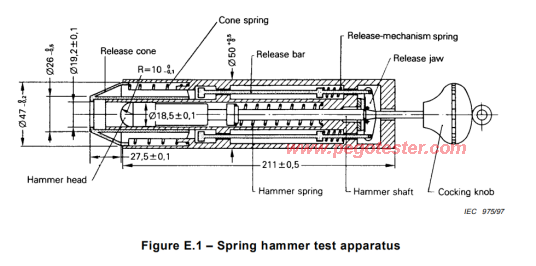
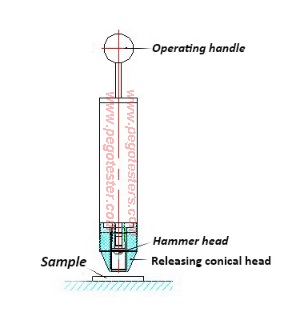
The spring hammer is composed of three main parts: the body, the striking element, and the release system.
2.1 The Body
This includes the housing, the guide for the striking element, the release mechanism, and all components that are firmly attached to it. The body provides the framework and support for the other parts of the spring hammer.
2.2 The Striking Element
It consists of the hammer head, the hammer shaft, and the cocking knob. For severities not exceeding 1J, the mass of this assembly is 250g. When the impact energy is 2J, the mass of the striking element assembly is 500g.
3. Working Principle
The operation of the spring impact hammer relies on the mass of the striking element and the movement of the hammer spring to generate standard energy. When the cocking knob is pulled, the release jaw drops onto the release point of the striking element. This action compresses the hammer spring, storing energy. The amount of compression determines the energy released. Factories calibrate different compression levels to specific energies using a spring hammer calibrator.
4. Application and Reference Standard
The mechanical impact tester is designed in accordance with IEC60068-2-75 and GB2423.55 standards. It finds application in testing the mechanical impact strength of various parts in household and similar electrical products, such as housings, operating levers, handles, knobs, and indicator lights. Moreover, it can meet the test requirements of standards like IEC60598-1, IEC62262, and IEC60068-2- 63.
5. Understanding Test IK Levels
The spring hammer test apparatus is commonly deployed for tests with impact energies up to 2J, which corresponds to IK levels from IK01 to IK07. However, with technological advancements, an IK08/5J spring hammer has been developed. This higher energy version is specifically tailored for testing electric vehicle charging stations.
| IK01 | IK02 | IK03 | IK04 | IK05 | IK06 | IK07 | IK08 |
| 0.14J | 0.2J | 0.35J | 0.5J | 0.7J | 1J | 2J | 5J |
6. Material of the Shell and Striking Elements of Spring Hammer
6.1 Shell Material
The shell of the spring hammer is crafted from stainless steel. This material choice is strategic as stainless steel offers excellent durability, resisting wear and corrosion over time. It can withstand the rigors of repeated use and exposure to various environmental conditions, ensuring the long – term functionality of the test apparatus.
6.2 Striking Element Material
For spring hammers with an impact energy of 1J and below, the striking element is made of polyamide. For 2J and 5J spring hammers, the striking element is crafted from steel.
7. Step – by – Step Guide to Operating the Spring Hammer Test
When using a spring hammer test apparatus, follow these steps:
First, securely fix the sample and select the appropriate impact energy and test position.
Next, pull the cocking knob of the spring hammer until you hear a distinct “click” sound. This indicates that the spring hammer is in the ready state.
Then, align the spring hammer vertically with the sample surface and ensure it makes contact. Slowly increase the pressure to retract the releasing conical head until the hammerhead is released to strike the enclosure.
8. PEGO Available Spring Hammer Models
| Model | Impact Energy | Equivalent Quality |
| IK01 (single operated) | 0.14±0.01J | 250g±2% |
| IK02 (single operated) | 0.20±0.02J | 250g±2% |
| IK03 (single operated) | 0.35±0.03J | 250g±2% |
| IK04 (single operated) | 0.50±0.04J | 250g±2% |
| IK05 (single operated) | 0.70±0.05J | 250g±2% |
| IK06 (single operated) | 1.00±0.05J | 250g±2% |
| Ik07 (single operated) | 2.00±0.10J | 500g±2% |
| IK08 (single operated) | 5±0.25J | 1.7kg±2% |
| IK01 – IK06 (adjustable type) | 0.14J~1.00J | 250g±2% |
This guide provides a comprehensive overview of the spring hammer test apparatus, covering its definition, structure, working principle, applications, and more, which is useful for anyone involved in product safety testing and quality control related to mechanical impact resistance.