Have you ever wondered if your phone would still work if it fell into hot pot soup or got sprayed directly with a high-pressure water gun? That’s exactly what IPX9 waterproof testing is meant to solve.
1. What is IPX9?
IPX9 is the highest waterproof rating in the International Protection Marking (IP Code), designed specifically for extreme high-temperature and high-pressure environments. According to the latest IEC 60529:2025 standard, its key testing parameters include: water temperature of 80±5℃ (almost boiling water), water pressure of 8000-10000kPa (80-100Bar, about 20 times the pressure in a car tire), spray angles of 0°, 30°, 60°and 90°, with 30 seconds per angle, totaling 2 minutes. This standard simulates scenarios like industrial cleaning or car washing with high-pressure water guns to check how well a device seals against high-temperature steam impact.

Unlike IPX8 (long-term immersion), IPX9 testing focuses more on protection against dynamic impacts. For example, parts in a car engine compartment need to withstand high-temperature, high-pressure washing from car washers, while consumer electronics like phones need to handle steam in hot springs or saunas. Additionally, IPX9K (for the automotive industry) extends the testing time to 1 minute per angle on top of IPX9 requirements and may include dust resistance (such as IP69K), making it even stricter.
2. IPX9 vs other waterproof ratings: What’s the difference?
Many people think a higher number means better waterproofing, but actually, different numbers correspond to different scenarios:
IPX7: Short-term immersion (e.g., a phone falling into a toilet, submerged in 1m of water for 30 minutes)
IPX8: Long-term diving (e.g., a diving watch working 100m underwater)
IPX9: High-temperature, high-pressure spraying (e.g., being sprayed by a high-pressure water gun during car washing)
For example: If your phone has an IPX8 rating, it can stay submerged in a swimming pool for 30 minutes, but it might break instantly if sprayed with 80℃ high-pressure water. A device with IPX9 certification, however, can handle both extreme scenarios.
3. Industry applications and typical cases
Automotive electronics: Car cameras and battery packs must pass IPX9 testing, otherwise they might short-circuit when sprayed with a high-pressure water gun. Changan New Energy’s “Golden Bell” battery even underwent 1 hour of high-temperature water spraying (the GB standard only requires 3 minutes) and still remained safe with no leaks.
Consumer electronics: The OPPO Find N5 foldable phone is the world’s first to support triple IPX6/8/9 certification. It can not only be submerged in 1.5m of water but also withstand 80℃ steam spraying, solving the problem of foldable screens being prone to water damage.
Outdoor equipment: If a camping power bank passes IPX9 certification, it can keep supplying power even in heavy rain or when splashed with hot water, avoiding the awkwardness of sudden power loss during camping.
Smart home: IPX9-certified smart door locks can resist high-temperature steam (e.g., in bathrooms), preventing circuit failure due to moisture and protecting home safety.
4. The significance of IPX9 testing
IPX9 testing essentially “backs up” the reliability of devices in extreme environments. It fills gaps in traditional waterproof standards, uses scientific testing methods to define a device’s protection against high-temperature, high-pressure impacts, ensures user safety and experience, and drives industry technology upgrades.
5. PEGO’s solution for IPX9 testing
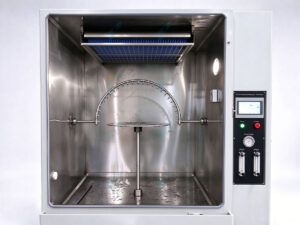
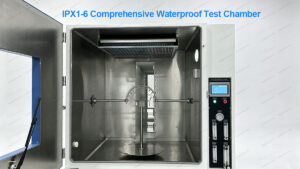
For IPX9 testing, PEGO has launched the IPX9K high-temperature and high-pressure test chamber. The chamber’s structure is fully designed to meet standards. Users can control the temperature and pressure inside via a PLC and touchscreen, and the chamber has built-in nozzles and a turntable. Its design makes testing simple and easy to operate.