In the field of electrical equipment, current-carrying hoses, as critical components for current transmission, their mechanical properties are directly related to the stability and safety of electrical systems. Based on standards such as IEC 60335-2-2, current-carrying hoses of vacuum cleaner need to pass a series of mechanical tests to verify their resistance to crushing, abrasion, flexing, torsion, and other working conditions, ensuring that basic insulation is not damaged and electrical strength meets specifications.
1. Crushing Resistance Test: A Barrier Against External Pressure
Current-carrying hoses need to have crushing resistance to withstand external pressure during installation or use. During the test, place the hose between two parallel steel plates. Each plate is 100 mm long, 50 mm wide, and the edges of the longer sides are rounded with a radius of 1 mm. The axis of the hose is positioned perpendicular to the longer sides of the plates, and the plates are placed at a distance of approximately 350 mm from one end of the hose. Press the steel plates together at a rate of 50 mm/min ± 5 mm/min until the applied force reaches 1.5 kN. After releasing the force, conduct an electric strength test on the hose (connect the conductors together and test with saline solution) to verify that the insulation performance is not damaged after crushing.
2. Abrasion Resistance Test: A Test for Long-Term Friction
During the long-term operation of equipment, current-carrying hoses may be damaged due to friction with surrounding components, so the abrasion resistance test is crucial. During the test, attach one end of the hose to the connecting rod of a crank mechanism. The crank rotates at 30 r/min, causing the end of the hose to move horizontally backwards and forwards over a distance of 300 mm. The hose is supported by a rotating smooth roller, and a belt of abrasive cloth (P100, as specified in ISO 6344-2) moves at a speed of 0.1 m/s. A mass of 1 kg is suspended from the other end of the hose, which is guided to avoid rotation. In the lowest position, the mass has a maximum distance of 600 mm from the centre of the roller. After the crank has made 100 revolutions, check whether the basic insulation is exposed and conduct an electric strength test.

3. Flexing Resistance Test: Durability for Dynamic Bending
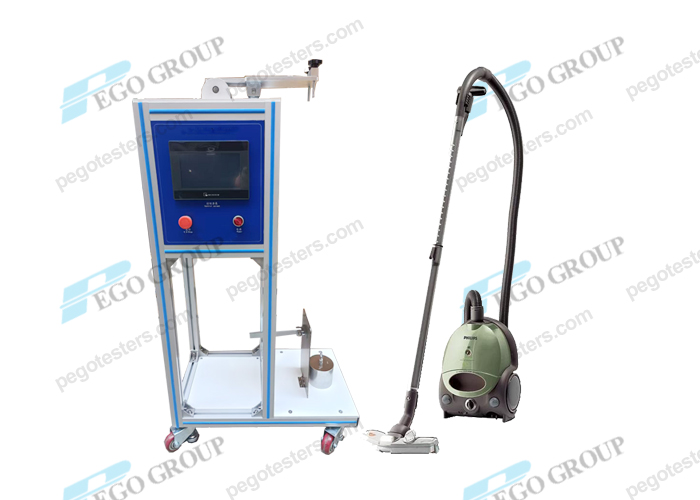
Current-carrying hoses need to bend frequently at the reciprocating moving parts of equipment (such as motorized cleaning heads), so the flexing resistance test needs to simulate this working condition. Attach the end of the hose intended to be connected to the motorized cleaning head to the pivoting arm’s endpoint as shown in Figure 102. The distance between the pivot axis of the arm and the point where the hose enters the rigid part is 300 mm ± 5 mm. The arm can be raised from the horizontal position by an angle of 40° ± 1°. A mass of 5 kg is suspended from the other end of the hose. When the arm is in the horizontal position, the mass is supported and there is no tension on the hose. If necessary, the mass may be repositioned during the test. The mass slides against an inclined plate so that the maximum deflection of the hose is 3°. The arm is raised and lowered by a crank that rotates at a speed of 10 r/min ± 1 r/min. The test is first carried out for 2 500 revolutions of the crank, after which the fixed end of the hose is turned through 90° and the test continued for a further 2 500 revolutions. The test is repeated in each of the other two 90° positions. If the hose ruptures before 10 000 revolutions of the crank, the flexing is terminated. After the test, an electric strength test shall be conducted to verify its insulation performance.

4. Torsion Resistance Test: Capability to Withstand Torsion Stress
Current-carrying hoses also need to withstand torsional stress. During the test, hold one end of the hose in a horizontal position with the remainder of the hose freely suspended. The free end is rotated in cycles, each cycle consisting of five turns in one direction and five turns in the opposite direction, at a rate of 10 turns per minute. After 2 000 cycles of the test, the hose shall withstand the electric strength test and shall not be damaged to such an extent that compliance with this standard is impaired.
Conclusion
Mechanical performance testing of current-carrying hoses is a key link in ensuring the safe operation of electrical equipment. Through multi-dimensional tests such as crushing, abrasion, flexing, and torsion, their reliability under complex working conditions can be fully verified. These tests are not only compliance requirements to meet IEC standards but also the core guarantee to ensure the insulation integrity and electrical strength of current-carrying hoses from design to production, building a solid mechanical performance defense for the long-term stable operation of electrical systems.