What happens when a 500g steel ball plummets from a height of 1.3m and strikes a smartphone screen? Does it result in a crack of spreading fractures, or does the screen remain intact? This seemingly simple scenario is a critical determinant of whether a product can withstand market scrutiny—and the steel ball drop test is the impartial judge of this “make-or-break trial.”
1. What is Steel Ball Drop Test?
The steel ball drop test evaluates the impact resistance of products or materials by simulating the free fall of a steel ball from a specific height. Widely used in electronics, packaging, building materials, toys, and other industries, it aims to verify a product’s ability to withstand mechanical impacts during transportation, use, or accidental drops, thereby ensuring product quality and safety.
The test targets various finished products (e.g., mobile phones, lamps, small appliances), packaging materials (e.g., cartons, cushioning foam), and components (e.g., glass panels, plastic casings). It detects issues such as breakage or functional failure through the impact of the falling steel ball.
2. Test Principle of Steel Ball Drop Test
Based on the principle of free fall, the test involves releasing a steel ball of specified weight from a set height to strike the test sample, simulating real-world impact scenarios. Upon impact, the kinetic energy of the steel ball is rapidly transferred to the sample, subjecting it to a large impact force. Depending on material properties, the sample may undergo elastic deformation, plastic deformation, cracking, or even fragmentation.
By observing and measuring the sample’s damage (e.g., crack initiation and propagation, deformation, or fragmentation) and recording parameters such as impact energy and peak impact force, the material’s impact resistance can be scientifically evaluated.
The formula for impact energy is: E = mgh
E = impact energy (unit: Joule, J)
m = mass of the steel ball (unit: kilogram, kg)
g = gravitational acceleration (approximately 9.8m/s²)
h = drop height (unit: meter, m)
This formula shows that impact energy is proportional to the steel ball’s mass and drop height. By adjusting these parameters, impacts of different energy levels can be simulated to meet testing needs for various materials and products.
3. Ball Drop Tester
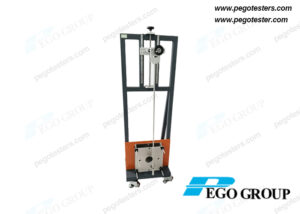
The ball drop tester is the core equipment for the steel ball drop test, consisting of the following key components: steel ball, electromagnet, drop rod and sample fixing device.
3.1 Steel Ball
As the impact source, the steel ball’s size and weight strictly follow international or industry standards to ensure accurate and comparable test results. Depending on requirements, steel balls of different masses (e.g., 100g, 500g, 1kg, 10kg) and diameters are selected.
For example, standards such as IEC60598-1, IEC60950-1, AS-NZS61439.4, and IEC60601-1 specify a steel ball with 500g mass and φ50mm dropped from 1.3m to verify the mechanical strength of lamps, glass panels and etc..
However, in some specific industry standards, a 10kg steel ball dropped from a specified height is used to conduct IK12 to IK20 tests through energy conversion.
| Weight | Height | Test Type | Impact Energy | Class |
| 10 kg | 625 mm | Drop | 62.5 Joules | IK 12 |
| 10 kg | 750 mm | Drop | 75 Joules | IK 13 |
| 10 kg | 1000 mm | Drop | 100 Joules | IK 14 |
| 10 kg | 1250 mm | Drop | 125 Joules | IK 15 |
| 10 kg | 1500 mm | Drop | 150 Joules | IK 16 |
| 10 kg | 1750 mm | Drop | 175 Joules | IK 17 |
| 10 kg | 2000 mm | Drop | 200 Joules | IK 18 |
| 10 kg | 2250 mm | Drop | 225 Joules | IK 19 |
| 10 kg | 2500 mm | Drop | 250 Joules | IK 20 |
3.2 Electromagnet
Used to hold and release the steel ball, with an electronic control system for precise timing. The electromagnet must have sufficient holding force to secure the ball during preparation and release it quickly without interfering with its initial falling speed.
3.3 Drop Rod
Supports the steel ball and adjusts the drop height. Typically a high-precision straight rod with clear scales, it allows accurate height setting using tape measures, squares, or other calibration tools.
3.4 Sample Fixing Device
A custom test bench designed for the sample’s shape and size, with surrounding guardrails to prevent the steel ball from rolling and causing injury or damage after impact.
4. In Summary
Through the steel ball drop test, enterprises can scientifically and quantitatively evaluate product performance, ensuring quality and reliability for consumers.
5. Why Pego?
Professional testing demands reliable equipment. PEGO’s steel ball drop device is precisely engineered to be your product’s “performance inspector.” Standard steel balls crafted from high-carbon steel guarantee stable transfer of impact energy; millimeter-precision drop rods ensure exact height settings every time; and an intelligent electromagnetic control system ensures the steel ball achieves true free fall upon release. With a full range of steel ball weights from 100g to 10kg, it covers testing needs across all product categories—from lamp panels to industrial components. Whether it’s basic verification per IEC standards or high-level IK12 to IK20 assessments, this device handles it all with ease.
What’s more, we understand that enterprises often have diverse and complex testing needs. When steel ball drop tests meet IK hammer tests, there’s no need to worry about the cost or space of purchasing two separate devices—PEGO’s innovative integrated testing machine combines both core functions into one. With a single click to switch modes, it seamlessly performs precise steel ball impact tests and IK rating evaluations, maximizing equipment utilization and streamlining testing workflows.