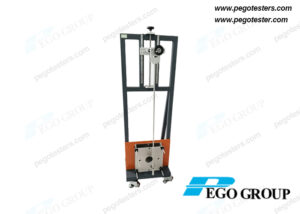
In modern manufacturing and scientific research, accurate testing of material properties is crucial. As a professional testing device, the ball pressure test apparatus plays a key role in evaluating the heat resistance of materials and serves as an important tool for ensuring product quality and safety.
1. Overview of Uses
The ball pressure test apparatus is primarily used to test the heat resistance of non-metallic materials and solid electrical insulating materials excluding ceramics. It is indispensable in the production process of various electrical and electronic products and their components, such as electrical equipment, lighting equipment, low-voltage electrical appliances, household appliances, machine tool electrical appliances, motors, power tools, electronic instruments, electrical meters, information technology equipment, electrical office equipment, electrical connectors and accessories. It is also essential in quality control for industries like insulating materials and engineering plastics. By simulating the actual service conditions of materials under high temperature and pressure, the tester can effectively determine whether materials can withstand high temperatures without deformation or performance degradation, ensuring the safety and reliability of products during long-term use.
2. Working Principleof Ball Pressure Test
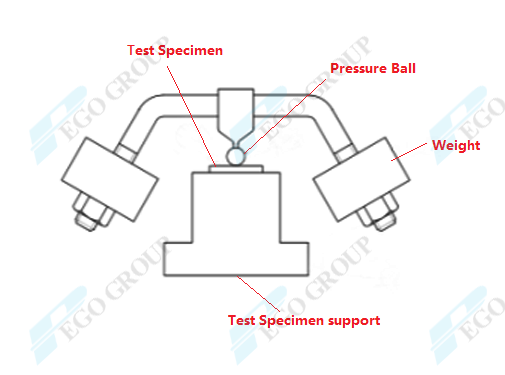
The working principle of the ball pressure test is based on the deformation characteristics of materials under the combined action of high temperature and pressure. During the test, an operator presses a steel ball with a diameter of 5mm (radius 2.5mm) vertically onto the surface of the horizontally placed test material under a specific pressure of 20N±0.2N. Subsequently, the entire device is placed into a heating cabinet, where the temperature is precisely set according to different testing standards and material properties, with common temperatures such as 125°C and 150°C.
In a high-temperature environment, the internal molecular movement of the material intensifies, challenging its structural stability. If the material has good heat resistance and can resist the dual effects of high temperature and pressure, only a small indentation will be left on its surface by the steel ball; conversely, if the heat resistance is poor, the material will undergo significant deformation, and the diameter of the indentation will increase accordingly. After the test, operators use high-precision measuring tools (such as microscopes, laser measuring instruments, etc.) to measure the diameter of the indentation on the material surface, which serves as a key indicator for judging the material’s resistance to heat-induced deformation. Many electrical safety standards stipulate that an indentation diameter not exceeding 2mm indicates that the material meets the requirements for heat-induced deformation resistance under the corresponding conditions.
3. Technical Parameters
3.1 Pressure ball parameters: The steel ball has a diameter of 5mm with an accuracy of ±0.05mm, ensuring the accuracy and consistency of the applied pressure; the pressure exerted by the ball indenter is 20N±0.2N (including the total weight of the loading device and the ball), simulating pressure conditions in real service scenarios.
3.2 Test specimen support: The support has a height of 100mm and a diameter of 50mm, with a 1.2mm diameter hole inside for placing samples and performing related auxiliary operations; it is made of stainless steel, which has good high-temperature resistance and stability, ensuring that the testing process is not disturbed by external factors.
3.3 Material: The main components of the ball pressure test apparatus are made of stainless steel, which is sturdy and durable, resistant to high-temperature environments and chemical corrosion; the steel ball is made of hardened steel, ensuring that its shape and hardness remain unchanged during multiple tests, thus guaranteeing the reliability of test results.
3.4 Compliance with standards: The ball pressure test apparatus strictly complies with numerous electrical safety standards, such as IEC 60695-10-2, IEC 60884-1, IEC 60320-1, IEC 60335-1, IEC 60598-1, and IEC 60950-1. It meets the high-standard testing requirements of different industries and customers.
4. Application Fieldsof the Ball Pressure Test Apparatus
4.1 Electrical product industry: In the production of electrical equipment, from large power distribution cabinets to small electronic components, their housings and internal insulating parts must undergo ball pressure testing. For example, the internal plastic parts of common sockets and switches need to withstand plugging/unplugging pressure and heat generated by electric current; the ball pressure tester can detect the performance of these parts under high temperature and pressure to ensure safe use. For complex electrical control systems, ball pressure testing ensures that insulating materials maintain good insulating properties in high-temperature environments during long-term operation, preventing accidents such as electric leakage and short circuits.
4.2 Lighting equipment industry: Whether it is ordinary LED bulbs or high-end stage lighting equipment, their housing materials must maintain shape stability when heated during long-term operation to avoid safety hazards caused by deformation and rupture. The ball pressure tester can inspect the housings and internal insulating materials of various lighting equipment, ensuring product safety throughout their service life.
4.3 Insulating materials and engineering plastics industry: Insulating materials are used to isolate live parts and prevent electric shock, and their heat resistance is directly related to electrical safety. Engineering plastics are widely used in electrical product housings and internal structural parts. The ball pressure tester helps enterprises evaluate material quality, ensuring that the produced materials meet electrical safety standards, providing reliable raw materials for downstream electrical product manufacturers, and promoting the improvement of product quality throughout the industrial chain.