As the automotive industry rapidly evolves toward intelligence and electrification, the reliability of vehicle components directly defines vehicle safety and user experience. In harsh and variable operating environments—from dusty deserts and Gobi landscapes to rainy coastal regions, from high-pressure car washing to long-term outdoor weathering—ensuring components resist dust and water ingress has become a central industry challenge. As the international standard defining dust and water protection classes for road vehicles, ISO 20653 delivers a consistent, rigorous technical framework worldwide, serving as a critical pillar for enhancing vehicle durability and strengthening product competitiveness.
1. Core Purpose and Development of ISO 20653
Officially titled Road vehicles – Degrees of protection (IP code) – Protection of electrical equipment against foreign objects, water and Access, ISO 20653 is developed by ISO/TC 22, the ISO Technical Committee for Road Vehicles. It specifies the ability of road vehicles and their components to resist dust, water, and accidental contact with hazardous parts, applying to all road vehicles and key components such as exterior trims and electrical assemblies.
2. Core Content: Protection Classes and Test Specifications
At the heart of ISO 20653 lies the Ingress Protection (IP) Code classification system. Two digits denote dust protection and water protection respectively, with higher values indicating stronger resistance. The standard also includes safeguards against accidental human contact with live or moving parts, forming a three-dimensional protection framework: dust protection + water protection + contact protection, delivering clear guidance for component design, manufacturing, and compliance testing.
2.1 Protection Class Definitions
An IP rating follows the format: IP + two digits.
- 1st digit: dust protection (0–6)
- 2nd digit: water protection (0–8). One digit may be omitted for single-attribute rating (e.g., IP6X for dust only, IPX8 for water only).
|
Class |
Dust Protection (1st digit) |
Water Protection (2nd digit) |
|
0 |
No protection, dust and water enter freely |
No protection, water enters freely |
|
1 |
Protects against solid objects >50 mm (e.g., large stones) |
Protected against vertical dripping water |
|
2 |
Protects against solid objects >12.5 mm (e.g., small stones) |
Protected against dripping water when tilted up to 15° |
|
3 |
Protects against solid objects >2.5 mm (e.g., sand grains) |
Protected against spraying water |
|
4 |
Protects against solid objects >1.0 mm (e.g., fine sand) |
Protected against splashing water from any direction |
|
5 |
Dust-protected; limited dust ingress permitted without impairing function |
Protected against water jets |
|
6 |
Dust-tight; no dust ingress |
Protected against powerful water jets and wave splash |
|
7 |
— (no dust equivalent) |
Protected against temporary immersion (0.15 m depth, 30 minutes) |
|
8 |
— (no dust equivalent) |
Protected against continuous immersion (depth >1 m, per product specification) |
2.2 Key Test Procedures
ISO 20653 defines stringent, repeatable test sequences to ensure accuracy and impartiality, simulating real world dust and water exposure. The workflow comprises four essential steps:
1). Visual Inspection: Verify specimens are free of defects (cracks, deformation, damaged seals) and properly assembled to avoid skewed results.
2). Preconditioning: Subject samples to aging, temperature-humidity cycling, or other environmental stresses to mimic long term field conditions.
3). Specific Testing:
Dust testing: Expose specimens to controlled dust atmospheres for specified durations and assess ingress.
Water testing: Apply dripping, spraying, jetting, or immersion to replicate rain, high pressure washing, and water crossing.
4). Functional Verification: Post test, inspect physical condition and confirm full functional performance; only samples unaffected by dust or water ingress qualify for the rated class.
3. Industry Applications: Full Spectrum Vehicle Components
ISO 20653 is widely integrated into the design, production, and validation of complete vehicles and components. It is foundational for quality assurance in plastic parts, wiring harnesses, sensors, lamps, and other critical assemblies, with ratings tailored to mounting location and service environment.
3.1 Automotive Plastic Components
Lightweight and corrosion resistant plastics dominate exterior and interior trims. Exterior parts typically require IP54 or higher to withstand outdoor exposure. Interior parts may use lower ratings but must maintain basic dust protection for appearance and service life.
3.2 Electrical and Electronic Components
Harnesses, sensors, charging ports, and other electronics are highly vulnerable to dust and moisture. Failure risks short circuits, malfunctions, or safety hazards, requiring strict, location specific IP ratings.
3.3 New-Energy Vehicles
The standard is indispensable for electrified mobility. Core assemblies such as battery packs demand significantly higher protection than conventional internal combustion vehicles, commonly requiring IP67 or IP68 for safe operation under flooding and heavy rain.
4. PEGO Test Solutions for ISO 20653 Compliance
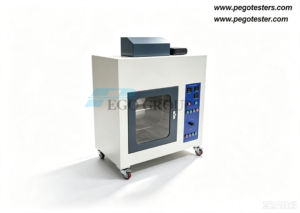
As the globally harmonized benchmark for automotive environmental protection, ISO 20653 drives product quality and industry wide sustainable development. To support full compliance, PEGO offers end to end testing systems covering dust testing IP1X–IP6X and water testing IPX1–IPX8, delivering robust validation to help manufacturers meet standard requirements reliably.