This article presents an in-depth analysis of waterproof rain test chambers, highlighting their critical role in evaluating enclosure protection grades against water ingress. By exploring the technical innovations and operational frameworks of PEGO PG-IPX36 waterproof testing machine, this paper demonstrates how these systems ensure compliance with global standards like IEC60529. Real-world applications and performance data are integrated to illustrate their impact on product reliability and market competitiveness.
1. Introduction
In an era where electronic and electrical devices must withstand diverse environmental challenges, the ability to resist water damage is non-negotiable. Waterproof rain test chambers serve as the cornerstone of quality assurance, providing controlled environments to simulate real-world water exposure. These systems are essential for manufacturers to validate enclosure designs, ensuring products meet rigorous IP (Ingress Protection) standards and safeguard user safety. This article examines the design, functionality, and application of the PEGO PG-IP IP Waterproof Test Equipment in conducting rigorous waterproof testing.
2. Core Principles of Waterproof Testing
2.1 Simulating Real-World Scenarios
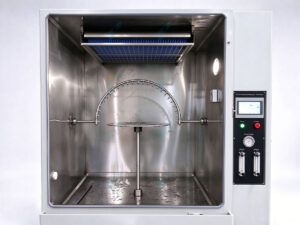
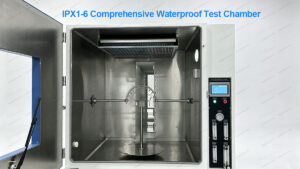
Waterproof rain test chambers replicate various water exposure scenarios, from gentle sprays to high-pressure jets, corresponding to IPX3 to IPX6 grades. Key mechanisms include:
Precision Water Spray Systems: Utilizing calibrated nozzles to deliver uniform water distribution, critical for IPX3 (angled spraying) and IPX4 (omni-directional splashing) tests.
Dynamic Testing Platforms: Rotating tables (1–5 rpm adjustable) ensure 360° exposure, eliminating testing biases and ensuring consistent results.
Pressure and Flow Control: Advanced regulators maintain water pressure (50–150 kPa) and flow rates, aligning with standards for IPX5 (12.5 L/min jets) and IPX6 (100 L/min powerful jets).
2.2 Technical Specifications of PG-IPX36
IPX3-4 Parameter | |
Tube Radius (mm) | R200, R400, R600, R800, R1000, R1200, R1400, R1600 for selection |
Aperture of nozzles (mm) | 0.4 |
Space between nozzles (mm) | 50 |
Tube Angel | ±1200 (IPX3), ±3500 (IPX4) or user-define |
IPX5-6 Parameters | |
Diameter of IPX5 Nozzle (mm) | 6.3 |
Diameter of IPX6 Nozzle (mm) | 12.5 |
Delivery rate for IPX5 (L/Min) | 12.5±0.625 |
Delivery rate for IPX6 (L/Min) | 100±5 |
Turntable diameter | |
Diameter of Turntable (mm) | Ø600, Ø60800, Ø1000 for selection |
Speed of Turntable | 1-5r/min |
3. Industry Applications and Performance Insights
3.1 Consumer Electronics:
Testing smartphones and smartwatches for IP68 compliance, ensuring durability in rain or accidental submersion.
3.2 Automotive Sector:
Validating headlights, taillights, and sensor enclosures against road water splashes (IPX4) and high pressure cleaning (IPX5).
3.3 Outdoor Equipment:
Certifying outdoor lighting, security cameras, and industrial sensors for resistance to extreme weather (IPX6).
4. Advantages of PEGO PG-IP36Testing Machine
4.1 Unmatched Precision: It guarantees precise replication of environmental conditions.
4.2 Scalability: Adaptable designs accommodate small components (e.g., earbuds) and large enclosures (e.g., industrial control panels).
4.3 Operational Efficiency: Easy operation.
5. Conclusion
PEGO PG-IP Waterproof rain test chambers are indispensable for maintaining product integrity in a water-centric world. By combining scientific precision with industrial adaptability, these systems not only validate compliance but also drive innovation—enabling manufacturers to deliver resilient, trusted products. As global standards continue to rise, the role of advanced testing equipment in shaping safer, more reliable technologies will only grow more critical.
6. References
IEC60529: Degrees of Protection Provided by Enclosures (IP Code).